

CITB TWCTC vs. TWSTC: Do You Need a Temporary Works Coordinator or Supervisor Course?
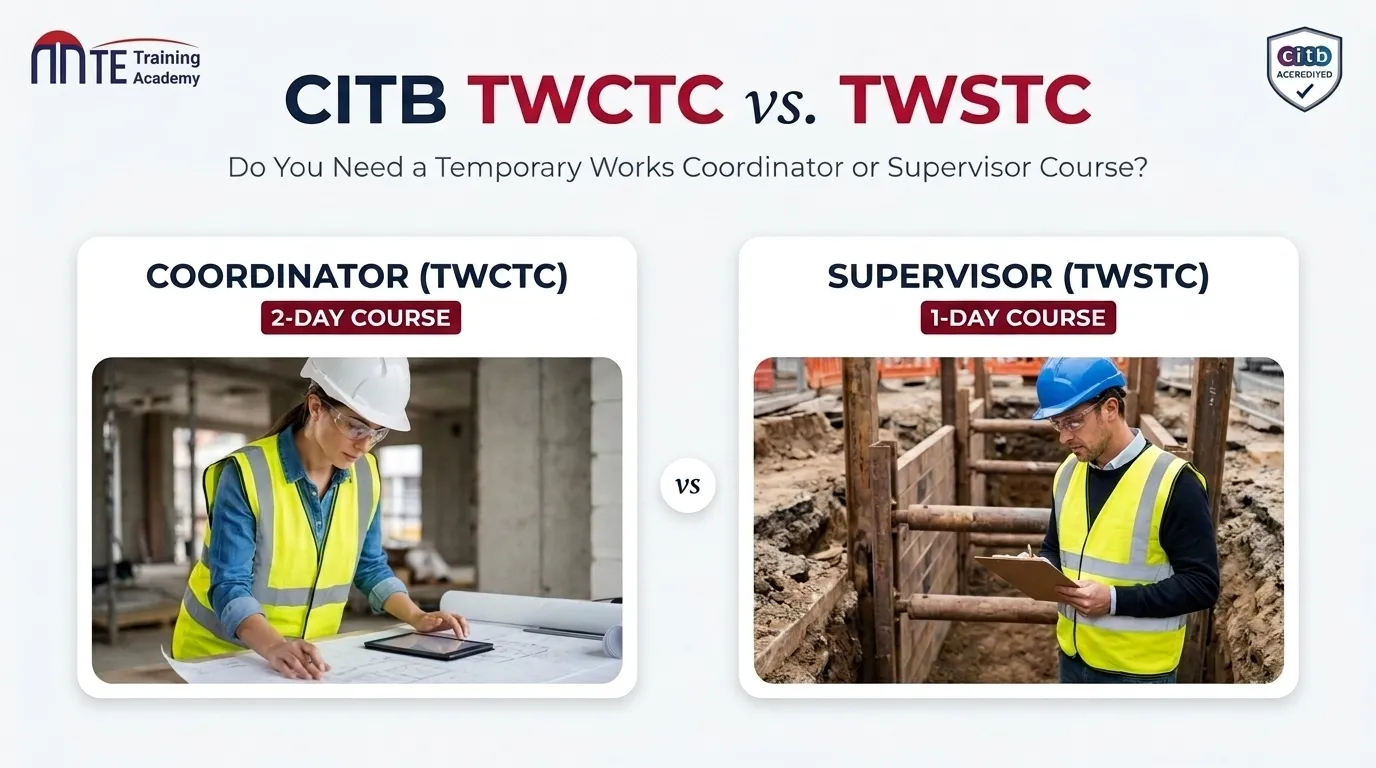
The core difference between the CITB Temporary Works Coordinator Training Course (TWCTC) and the Temporary Works Supervisor Training Course (TWSTC) lies in procedural management versus physical site inspection. A Temporary Works Coordinator (TWC) holds overall project-wide responsibility for managing the temporary works procedure, maintaining the temporary works register, categorising design checks under BS 5975, and issuing formal permits to load or strike. Conversely, a Temporary Works Supervisor (TWS) works on the frontline to assist the TWC, physically supervising the erection, use, maintenance, and dismantling of temporary structures against approved drawings. If you manage multi-trade interfaces and sign off permits, you must take the 2-day TWCTC; if you supervise trade gangs installing propping, shoring, or falsework on the ground, you need the 1-day TWSTC.
Choosing the wrong temporary works course is one of the most expensive compliance errors UK contractors make.Below, we break down the exact statutory, operational, and examination differences between the CITB temporary works coordinator and supervisor qualifications so you can book with complete confidence.
1. At a Glance: CITB TWCTC vs. TWSTC Comparison Table
For commercial managers, HR coordinators, and prospective delegates comparing temporary works courses, this table summarises the core operational and regulatory distinctions:
| Feature / Criteria | CITB Temporary Works Coordinator (TWCTC) | CITB Temporary Works Supervisor (TWSTC) |
|---|---|---|
| Course Duration | 2 Days (Minimum 14 hours classroom or live virtual delivery, excluding exam time) | 1 Day (Minimum 7 hours classroom or live virtual delivery, excluding exam time) |
| Primary BS 5975 Role | Strategic temporary works coordination, register management, design brief compilation, and issuing permits. | Frontline physical supervision of erection, alteration, maintenance, and dismantling on site. |
| Authority to Issue Permits? | Yes, authorised to issue Permits to Load and Permits to Strike/Dismantle (unless restricted by the DI). | No, inspects works and reports compliance to the TWC, unless specifically authorised on low-risk items. |
| Target Job Roles | Project Managers, Site Managers, Senior Site Engineers, Principal Contractor Leads. | Foremen, Trade Supervisors, Gangers, Junior Engineers, Subcontractor Supervisors. |
| CITB Assessment Format | 45-minute open-book exam (18 multiple-choice + 3 mandatory text/scenario questions). | 45-minute open-book exam (17 multiple-choice + 3 mandatory text/scenario questions). |
| Pass Mark Required | 78% overall (21/27 marks, including all mandatory safety questions). | 76% overall (19/25 marks, including all mandatory safety-critical questions). |
| Certificate Validity | 5 Years (renewable via the 1-day temporary works coordinator refresher course). | 5 Years (renewable by retaking the 1-day TWSTC or progressing to TWCTC). |
If your role involves managing the temporary works register, liaising with structural designers, and signing off permits rather than solely inspecting physical installations, you will need to book the accredited 2-day CITB Temporary Works Coordinator (TWC) course.
2. What is a Temporary Works Coordinator (TWC) and What Do They Do?
When construction professionals ask "what is a temporary works coordinator?" or "what does a temporary works coordinator do?", the answer goes back to the landmark 1975 Bragg Report following the collapse of the Loddon Viaduct. The report identified that catastrophic falsework failures rarely happen because of a single broken prop; they happen because nobody has overarching authority over the interfaces between permanent design, temporary engineering, and site execution.
Under BS 5975 (the British Standard Code of Practice for Temporary Works Procedures), the temporary works coordinator role is an administrative and managerial control function, not a design role. A temporary works co-ordinator is formally appointed by the Principal Contractor’s Designated Individual (DI) to ensure the company's temporary works management plan is followed to the letter.
Core Temporary Works Coordinator Duties & Responsibilities
On an active UK project, official temporary works coordinator duties and temporary works coordinator responsibilities include:
- Establishing the Temporary Works Register: Identifying all temporary works items early in the pre-construction phase and logging them in a central temporary works schedule.
- Preparing the Design Brief: Compiling comprehensive geotechnical data, structural interfaces, environmental wind/water loads, and construction sequences so the Temporary Works Designer (TWD) can produce a safe scheme.
- Assigning Design Check Categories (0 to 3): Determining the required level of design independence in accordance with HSE temporary works categories and BS 5975 (from Category 0 standard solutions like basic trench boxes up to Category 3 complex independent checks for deep basement propping or facade retention).
- Managing Multi-Contractor Interfaces: Ensuring that one subcontractor's excavation does not undermine an adjacent subcontractor's mobile crane outrigger mat or scaffold foundation.
- Executing Hold Points & Issuing Permits: Verifying that pre-erection checks, in-service inspections, and pre-load verifications are signed off before issuing a formal Permit to Load or Permit to Strike.
Because Tier 1 contractors and the Health and Safety Executive (HSE) scrutinise these procedures heavily, completing a recognised temporary works coordinator training course is the industry benchmark for demonstrating procedural knowledge.
3. What is a Temporary Works Supervisor (TWS)?
While the TWC sits at the procedural hub of a project, the Temporary Works Supervisor (TWS) acts as the TWC's "eyes and ears" out on the construction workface.
On large civil engineering projects, residential high-rises, or infrastructure frameworks (such as temporary works rail possessions involving Network Rail Form C temporary works), a single TWC cannot physically watch every concrete pour, trench sheet installation, or falsework erection simultaneously. BS 5975 allows for one or more TWS to be appointed to assist the TWC.
Key Responsibilities of a Temporary Works Supervisor
- Checking Materials Before Erection: Inspecting props, soldiers, walings, ties, and temporary works equipment on delivery to ensure components are undamaged and match the design specification.
- Supervising Physical Installation: Overseeing operatives to confirm the temporary structure is built strictly in accordance with the certified drawings, method statements, and temporary works risk assessment.
- Monitoring Environmental & Site Changes: Conducting routine visual checks using a daily temporary works checklist, checking for ground settlement after heavy rain, accidental plant impact on haul roads, or unauthorised removal of scaffold ties.
- Escalating Non-Conformances: Stopping work immediately and notifying the temporary works coordinator if site conditions deviate from the assumptions stated in the design brief.
4. How BS 5975 Defines the Hierarchy: DI, TWC, and TWS
Understanding what is outlined in a temporary works procedure requires looking at the three-tier management hierarchy established under BS 5975 and the Construction (Design and Management) Regulations 2015 (CDM 2015):
- The Designated Individual (DI): A senior director or board-level manager who holds ultimate statutory responsibility for establishing, auditing, and resourcing the organisation's corporate temporary works procedure. (Senior leaders often undertake dedicated temporary works designated individual training or a temporary works DI course to fulfil this governance duty).
- The Temporary Works Coordinator (TWC): Appointed directly by the DI via a formal temporary works coordinator appointment letter to manage all temporary works coordination on a specific project.
- The Temporary Works Supervisor (TWS): Appointed by the DI (or delegated through the TWC) to supervise specific packages, such as earthworks shoring, formwork, or temporary access trackway installation, and report directly to the Principal Contractor's TWC.
Crucial Compliance Note: Completing a twc course does not automatically make you the project's Temporary Works Coordinator. In the eyes of the HSE, temporary works certification is only one pillar of competence. To act legally as a TWC on site, you must hold three things: relevant site experience, a valid CITB temporary works coordinator certificate, and a signed appointment letter from your Designated Individual.
5. Course Syllabus, Exam Questions & Assessment Comparison
Both courses fall under the prestigious CITB Site Safety Plus scheme and centre around the "3 Ps" of temporary works failure prevention: People, Process, and Product. However, the depth of assessment differs significantly.
What to Expect on the 2-Day CITB TWCTC Course
During our classroom and CITB temporary works coordinator virtual course, delegates cover the full lifecycle of temporary works management across two intensive days:
- Statutory law (CDM 2015, Health and Safety at Work Act 1974) and the historical lessons of the Bragg Report.
- Deep-dive into BS 5975 Section 2, the "4 Cs" (Communication, Cooperation, Coordination, Competency), and the ERIC principle (Eliminate, Reduce, Inform, Control).
- Technical awareness of high-risk packages: crane working platforms, excavation support, falsework/formwork pressures, facade retention, and TG20 scaffolding compliance.
- The TWCTC Assessment: At the end of Day 2, delegates sit the temporary works coordinator exam. Searches for temporary works coordinator exam questions and CITB temporary works coordinator exam questions have grown rapidly because CITB updated the test to an open-book format. You have a 45-minute open book examination to answer 18 multiple-choice questions and 3 mandatory written review questions.
What to Expect on the 1-Day CITB TWSTC Course
The 1-day Supervisor syllabus compresses the administrative theory of design checks and focuses heavily on on-site risk control, supervision of method statements, and physical inspection hold points. Delegates complete a 45-minute open-book examination consisting of 17 multiple-choice questions and 3 mandatory written review questions.
6. Can a Temporary Works Coordinator Also Act as a Supervisor?
Yes. If you hold a valid temporary works coordinator qualification (TWCTC), you do not need to take the 1-day TWSTC course to act as a Temporary Works Supervisor.
Because the 2-day temporary works coordinator course covers the entirety of the BS 5975 procedural framework, including physical inspection protocols, hold points, and supervision interfaces, a qualified TWC is deemed fully trained to perform TWS duties on small-to-medium projects. Furthermore, when subcontractor supervisors attend a Principal Contractor's site to manage their own specialist packages (often referred to as Managing Contractor's TWC or TWS), Tier 1 contractors frequently prefer them to hold the full CITB temporary works coordinator training so they fully understand how their package integrates into the master temporary works register.
7. Other CITB Temporary Works Courses: General Awareness & Refresher
Beyond the core Coordinator and Supervisor routes, the CITB portfolio includes two additional pathways that frequently appear when researching temporary works qualifications:
- CITB Temporary Works General Awareness (TWGA): If you are an estimator, quantity surveyor, architect, or junior operative who needs a foundational understanding of site risks without taking on statutory appointment duties, this is a free, self-paced e-learning course (approximately 3 hours) available directly on the CITB website, rather than through TETA. The course (often searched as temporary works general awareness or CITB temporary works awareness) provides a high-level overview of BS 5975.
- CITB Temporary Works Coordinator Refresher Course (TWCTC-R): Ask any compliance officer "how long is a temporary works coordinator certificate valid for?" and they will remind you of CITB's strict 5-year expiry rule. Before your 5-year certificate lapses, you must complete the 1-day temporary works coordinator refresher course (also available as a temporary works coordinator refresher course online). If you miss your expiry date by even 24 hours, CITB removes your grace period eligibility, requiring you to sit the full 2-day CITB temporary works coordinator course online or in the classroom again.
8. Decision Matrix: Which CITB Temporary Works Training Course Should You Book?
Use this four-step checklist to select the right qualification for yourself or your team:
- Book the 2-Day TWCTC if: You are a Site Manager (holding SMSTS), Project Manager, Contracts Manager, or Site Engineer who will be named on the project's temporary works coordinator appointment letter, manage the register, review design check certificates, or sign off Permits to Load.
- Book the 2-Day TWCTC if: You are applying for temporary works coordinator jobs in the UK, where Tier 1 contractors mandate the full 2-day CITB certificate alongside a competitive temporary works coordinator salary.
- Book the 1-Day TWSTC if: You are a Trade Foreman, Groundworks Supervisor, Scaffolding/Falsework Ganger, or Assistant Engineer whose sole responsibility is checking physical installations on site and reporting back to an appointed TWC.
- Still on the Fence? Upgrade to the 2-Day TWCTC: For an extra day of study, the CITB temporary works coordinator course cost delivers vastly superior career mobility and qualifies you to act in both Coordinator and Supervisor capacities.
Ready to gain your 5-year CITB certification via remote live classroom or in-person training? View our upcoming dates, check temporary works coordinator course price options, and secure your place on our accredited CITB Temporary Works Coordinator (TWC) course today.
9. Frequently Asked Questions (FAQs)
Can I take the CITB Temporary Works Coordinator course online?
Yes. CITB fully approves remote delivery via a live virtual CITB temporary works coordinator course. You attend live interactive sessions via Zoom or Microsoft Teams with an accredited tutor over two days and sit your open-book exam online under remote invigilation, earning the exact same 5-year CITB certificate as classroom delegates.
What is the most common cause of temporary works failures on UK sites?
According to HSE investigations and BS 5975 reviews, the most common cause of temporary works failures is a breakdown in procedural communication, specifically failing to compile an accurate design brief for ground conditions, modifying temporary propping on site without consulting the Temporary Works Designer, or loading a structure before a formal pre-load inspection and Permit to Load have been completed.
Do I need engineering qualifications to attend a TWC course?
No formal structural engineering degree (such as an MSc temporary works or temporary works design course) is required to attend the CITB TWCTC. However, CITB recommends that delegates possess sound practical experience in construction operations and a working knowledge of site health and safety management (such as SMSTS or SSSTS).