

Does SMSTS Qualify You to Manage Temporary Works? (CITB TWC vs. SMSTS Explained)
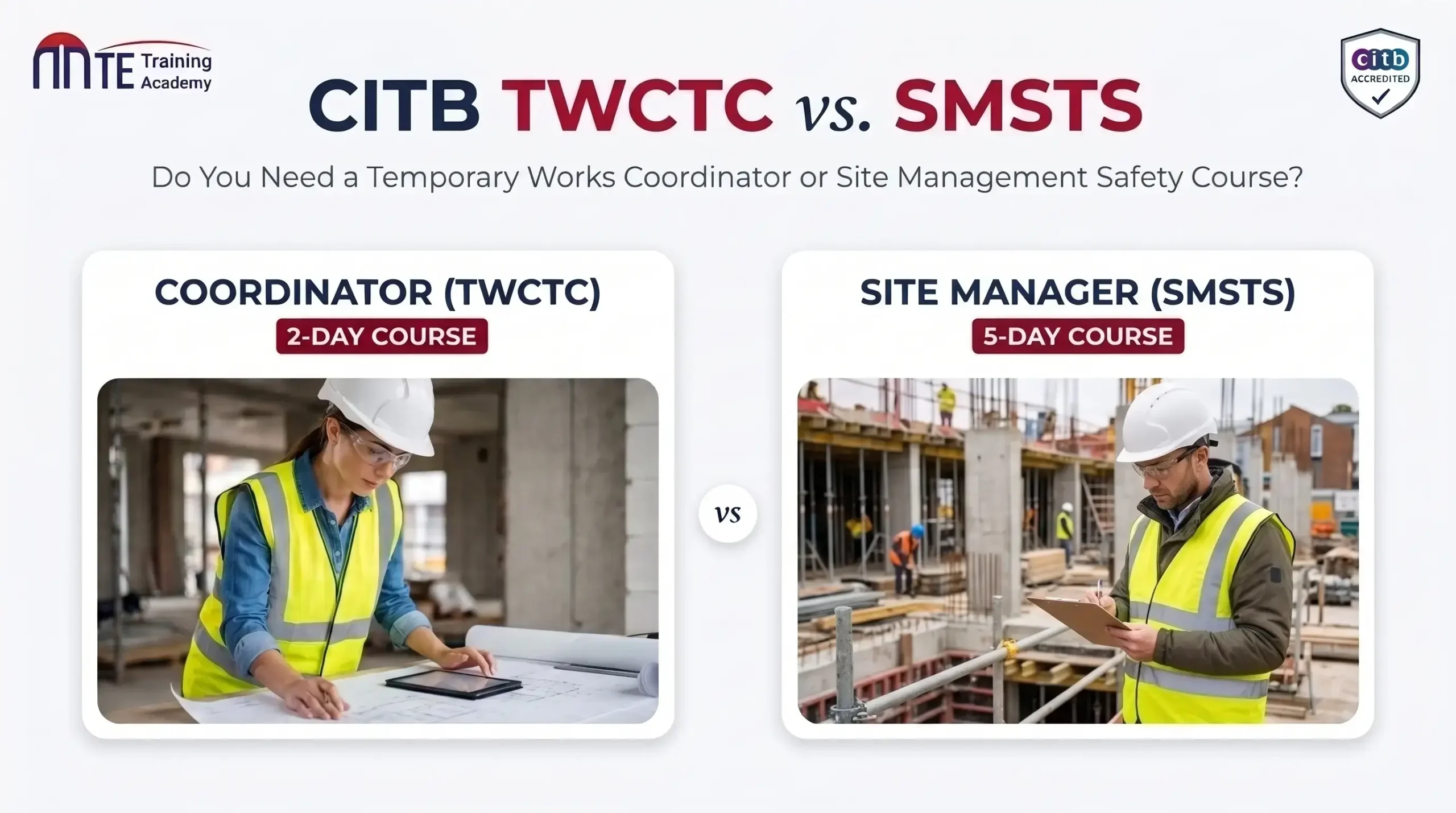
No, holding a valid CITB Site Management Safety Training Scheme (SMSTS) certificate does not automatically qualify you to act as a Temporary Works Coordinator (TWC) on a UK construction site. While the 5-day SMSTS qualification is the industry benchmark for general site health, safety, and welfare management, it only covers temporary works at an introductory awareness level. To manage temporary works procedures, maintain a temporary works register, and sign off permits in compliance with BS 5975-1:2024, Tier 1 principal contractors and the Health and Safety Executive (HSE) expect appointed personnel to complete the specialist 2-day CITB Temporary Works Coordinator (TWC) course.
Across UK building, civil engineering, and subterranean infrastructure projects, confusion between general site management qualifications and procedural temporary works governance remains one of the most common audit failures. Below, our tutors break down why does smsts cover temporary works coordinator is one of the most frequently asked compliance questions, and how the two qualifications work together on site.
The Short Answer: Why SMSTS Alone Is Not Enough for Temporary Works Coordination {#short-answer}
The misconception that an SMSTS holder can automatically step into the Temporary Works Coordinator role stems from how construction sites are structured. On many medium-sized projects, the Site Manager or Site Agent is the highest-ranking person permanently based on site. Because they hold a 5-day CITB SMSTS qualification, employers often assume they are covered to oversee every site operation, including scaffolding, trench shoring, falsework, and crane outrigger platforms.
However, SMSTS and TWCTC solve two fundamentally different problems:
- SMSTS focuses on broad statutory site safety: Over five days, delegates cover the Health and Safety at Work etc. Act 1974, CDM 2015 duties, working at height, confined spaces, demolition, occupational health, and behavioural safety. Temporary works occupies only a fraction of the syllabus, focusing on hazard recognition rather than procedural engineering control.
- TWCTC focuses on procedural engineering risk management: Temporary works fail catastrophically when design briefs, independent design checks, and physical pre-load inspections are disconnected. The 2-day CITB Temporary Works Coordinator Training Course (TWCTC) trains delegates specifically in BS 5975-1:2024 (Management procedures for the control of temporary works).
Put simply: SMSTS teaches you how to run a safe construction site; TWC teaches you how to coordinate the structural and geotechnical lifecycle of temporary installations from design brief to dismantling.

CITB TWC vs. SMSTS: Side-by-Side Qualification Comparison {#comparison-table}
To help training managers, civil engineers, and site agents evaluate how the two Site Safety Plus courses differ, review the technical comparison below:
| Feature / Criterion | CITB Temporary Works Coordinator (TWCTC) | CITB Site Management Safety Training Scheme (SMSTS) |
|---|---|---|
| Primary Purpose | Procedural coordination and governance of temporary works from concept to removal | Overall health, safety, welfare, and environmental management of a construction site |
| Governing Standard / Law | BS 5975-1:2024 (Code of Practice) & CDM Regulations 2015 | Health and Safety at Work Act 1974 & CDM Regulations 2015 |
| Course Duration | 2 Days (Classroom or Live Online) | 5 Days (Classroom or Live Online) |
| Core Syllabus Focus | The 4 Cs, Temporary Works Register, Design Briefs, Design Check Categories (0–3), Permits to Load & Strike | Risk Assessments, Method Statements (RAMS), Site Inductions, Working at Height, Excavations, Behavioural Safety |
| Final Assessment | 22 exam questions (including mandatory review questions) , Open-book referencing BS 5975 handbook | 25 exam questions (18 multiple-choice + 7 short written answers) |
| Certificate Validity | 5 Years (Renewed via 1-day TWC Refresher) | 5 Years (Renewed via 2-day SMSTS Refresher) |
| Qualifies You as TWC? | Yes (Provides the CITB training element required for formal appointment by a Designated Individual) | No (Provides general management safety awareness only) |
| Typical Delegate Profile | Civil Engineers, Senior Site Managers, Project Managers, Design Coordinators | Site Managers, Assistant Site Managers, Site Agents, Construction Directors |
Need to add formal Temporary Works Coordinator accreditation to your existing SMSTS? View live dates (Online / Classroom) and book directly on our CITB Temporary Works Coordinator (TWC) course page.
What BS 5975-1:2024 and CDM 2015 Actually Require {#bs5975-cdm2015}
In December 2024, the British Standards Institution (BSI) withdrew the older single-volume BS 5975:2019 standard and split it into two distinct parts:
- BS 5975-1:2024: Management procedures for the control of temporary works – Code of practice.
- BS 5975-2:2024: Falsework: design and implementation.
Under BS 5975-1:2024, every organisation involved in temporary works must appoint a senior Designated Individual (DI) at company level to establish and audit the company's temporary works procedure. For each project, the Principal Contractor (or Permanent Works Designer/Client, depending on contractual governance) must ensure a competent Temporary Works Coordinator (TWC) is formally appointed.
(Internal Cluster Link Note: For a full breakdown of the revised standard, read our companion guide: BS 5975 Explained: The Ultimate Guide to Temporary Works Procedures on UK Sites).
Why SMSTS Does Not Satisfy BS 5975-1:2024 Procedural Duties
An appointed TWC is responsible for coordinating technical workflows that are never taught on an SMSTS course, including:
- Compiling the Temporary Works Register: Identifying every temporary works element early in the pre-construction phase, from tower crane bases, haul roads, and sheet-piled cofferdams to façade retention and complex falsework.
- Issuing the Temporary Works Design Brief: Supplying the Temporary Works Designer (TWD) with accurate geotechnical ground investigation data, permanent works interface loads, concrete pour pressures, and phased construction sequences.
- Assigning Design Check Categories (Categories 0 to 3): Determining the level of independent design checking required based on structural complexity and risk:
- Category 0: Standard solutions (e.g., standard trench boxes or TG20-compliant tube and fitting scaffolds) checked by another member of the site or design team.
- Category 1: Simple designs checked by another engineer within the same design team.
- Category 2: More complex or novel designs checked by an independent engineer within the same organisation who was not involved in the original design.
- Category 3: Complex, innovative, or high-risk temporary works (such as deep urban tunnelling shafts, heavy propping adjacent to live rail, or non-standard cofferdams) checked by an entirely separate, external engineering consultancy.
- Controlling Hold Points via Formal Permits: Verifying that pre-load inspections have been conducted against the approved drawings before issuing a Permit to Load (or Permit to Bring into Use) and a Permit to Strike (Permit to Dismantle).
(Internal Cluster Link Note: See our step-by-step operational walkthrough in Temporary Works Permits Explained: Permit to Load, Unload, and Strike).
What Tier 1 Contractors and the HSE Expect From an Appointed TWC {#tier-1-expectations}
While BS 5975-1:2024 is an industry Code of Practice rather than an Act of Parliament, treating it as "optional" is a dangerous legal mistake. Under Regulation 19 of the Construction (Design and Management) Regulations 2015 (CDM 2015), contractors have an absolute statutory duty to ensure that any new or existing structure does not collapse or become unstable while in a temporary state. Furthermore, Regulation 8 of CDM 2015 mandates that anyone appointed to work on a project must possess the necessary skills, knowledge, training, and experience (SKTE).
When an HSE Inspector visits a site, or investigates a structural near-miss, they benchmark your site's management system directly against BS 5975-1:2024. If a Site Manager with only an SMSTS certificate is signing off temporary works registers or allowing concrete pours into unverified formwork without formal TWC training, the Principal Contractor faces immediate enforcement action (Improvement or Prohibition Notices) and severe liability under the Health and Safety at Work etc. Act 1974.
For this reason, Build UK, major Tier 1 infrastructure contractors, and client bodies (such as National Highways, Network Rail, and Thames Water) mandate the CITB TWCTC certificate as a non-negotiable pre-qualification requirement for anyone named as the project TWC.
If you already hold your SMSTS and need to bridge the compliance gap required by Tier 1 contractors, secure your spot on our accredited CITB Temporary Works Coordinator course.
Can a Site Manager Act as Both the SMSTS Manager and the TWC? {#dual-role}
Yes, provided they hold both qualifications, have sufficient site capacity, and there is no conflict of interest that compromises safety.
On small-to-medium construction projects, it is routine for a single Site Manager or Senior Site Engineer to hold both a valid SMSTS certificate and a valid CITB TWC certificate, fulfilling both roles simultaneously. However, BS 5975-1:2024 highlights two critical guardrails when combining roles:
- Independence from Production Pressure: Historically, the TWC role was created following the 1972 Loddon Viaduct falsework collapse and the subsequent Bragg Report (1975), which revealed that site managers under commercial pressure to meet concrete pour deadlines were cutting corners on temporary works checks. If a Site Manager acts as the TWC, the company’s Designated Individual (DI) must ensure commercial programme pressures never override temporary works hold points.
- Delegating On-Site Supervision on Large Projects: On major civil engineering, basement excavation, or tunnelling schemes, a single Coordinator cannot physically inspect every propping frame, falsework tower, and excavation batter across a sprawling site. In these environments, the TWC manages the overarching register and design checks, while appointing one or more Temporary Works Supervisors (TWS) to carry out daily physical inspections on the ground. Foremen, gangers, and junior engineers supporting the TWC should complete the 1-day CITB Temporary Works Supervisor Training Course (TWS).
(Internal Cluster Link Note: Unsure whether your staff need the 2-day Coordinator or 1-day Supervisor qualification? Compare them in our guide: CITB TWCTC vs. TWSTC: Do You Need a Temporary Works Coordinator or Supervisor Course?)
The 3 Pillars of TWC Appointment: Training, Experience, and Formal Authorisation {#three-pillars}
Passing the 2-day CITB TWCTC course is a vital milestone, but tutors emphasise a golden rule during training: a certificate alone does not make you a Temporary Works Coordinator, formal appointment does.
Under BS 5975-1:2024, becoming an active TWC requires three pillars working in tandem:
- Recognised Training (Knowledge): Completing the 2-day CITB Temporary Works Coordinator (TWCTC) training (and renewing it every five years via the 1-day CITB TWC Refresher course before expiry) proves you understand the BS 5975 procedural framework and the "4 Cs" (Communication, Cooperation, Coordination, and Competency).
- Relevant Operational Experience (Skills & Experience): A TWC managing a standard low-rise residential housing site requires different technical experience than a TWC coordinating Category 3 deep shaft sinking or façade retention on a central London demolition project. Your practical engineering or site background must match the risk profile of the project.
- Formal Written Appointment by the Designated Individual (Authority): You cannot legally act as a TWC until your company's Designated Individual (DI) assesses your competence, issues a formal TWC Appointment Letter for the specific project, and you sign to accept the duties and authority (including the authority to stop work if temporary works are unsafe).

Temporary Works Coordinator Entry Requirements: Do You Need SMSTS First? {#entry-requirements}
If you are an aspiring coordinator, design engineer, or site supervisor researching temporary works coordinator entry requirements, you do not need to hold an SMSTS or SSSTS certificate as a mandatory prerequisite to book the CITB TWC course.
While holding an SMSTS certificate or SSSTS certificate provides helpful context around CDM 2015 and general site safety, CITB sets no formal prior certification barrier for TWCTC. Instead, delegates should possess:
- Practical construction or engineering familiarity: Working knowledge of how construction sites operate, typically gained as a site engineer, civil engineer, site manager, contracts manager, or experienced supervisor.
- Ability to interpret technical documentation: Confidence reading construction drawings, risk assessments, method statements (RAMS), and structural design briefs.
- Proficiency in English: A good grasp of spoken and written English to participate in group case-study workshops (such as compiling sample registers) and complete the end-of-course assessment.
Combining SMSTS and TWC for Career Progression
For site managers and civil engineers looking to maximise their employability, or progressing toward a Level 6 NVQ Diploma in Construction Site Management (Black CSCS Manager Card) holding both SMSTS and TWC is the gold standard on a UK construction CV.
Frequently Asked Questions (FAQs)
1. Does SMSTS cover temporary works?
SMSTS covers temporary works only at a high-level awareness stage so site managers can recognise common hazards (such as overloaded scaffolding or unsupported excavations). It does not cover the detailed procedural management of temporary works registers, design check categories (0–3), or permit-to-load governance required by BS 5975-1:2024.
2. Can I be appointed as a Temporary Works Coordinator with just an SMSTS certificate?
Legally, BS 5975-1:2024 requires the Designated Individual to appoint a "competent" TWC. However, in practice across the UK construction industry, Tier 1 principal contractors, insurance underwriters, and HSE inspectors treat the 2-day CITB Temporary Works Coordinator Training Course (TWCTC) as the baseline evidence of procedural training. Relying solely on SMSTS will normally result in pre-qualification or site audit rejection.
3. Should I take SMSTS or TWC first?
If your primary job is running overall site health, safety, and welfare as a Site Manager, take the 5-day SMSTS first. If you are a Site Engineer, Project Engineer, or Subcontractor Manager specifically tasked with coordinating propping, excavations, crane platforms, or falsework designs, you can take the 2-day CITB TWC course straight away without needing SMSTS first.
4. How long does the CITB Temporary Works Coordinator certificate last?
Like SMSTS, the CITB TWCTC certificate is valid for 5 years. Before the 5-year expiry date lapses, you must complete the 1-day CITB TWC Refresher (TWCTC-R) course. CITB offers no grace period, if your certificate expires by even a single day, you must retake the full 2-day course.
Unlike generalist training brokers, TE Training Academy is the dedicated specialist training division of Tunnel Engineering Limited. Led by a practising civil engineer, our CITB Courses are delivered by an elite team of geotechnical specialists and veteran health and safety practitioners who manage complex Category 2 and Category 3 temporary works in the real world.
- Format: 2-Day Live Online Virtual Classroom or London Classroom
- Accreditation: Official 5-Year CITB Site Safety Plus Certificate (Free Resit Available subject to CITB eligibility)
Need private group training or on-site corporate delivery? Call our advisory team in Tonbridge, Kent on 01732 445780 or email hello@tetrainingacademy.co.uk.