

BS 5975:2019 vs BS 5975-1 & -2:2024: What Returning Temporary Works Coordinators Must Know Before Their Refresher
Key Takeaway for Returning Coordinators (Quick Summary):
On 31 December 2024, the British Standards Institution (BSI) officially withdrew BS 5975:2019 and split the code of practice into two standalone standards: BS 5975-1:2024 (Management procedures for the control of temporary works) and BS 5975-2:2024 (Falsework: Design and implementation). If you passed your initial two-day qualification or previous renewal in 2021 or 2022, your original training was assessed against a retired standard. Attending a 1-day CITB Temporary Works Co-ordinator Refresher (TWC Refresher) before your five-year certificate expires updates your working knowledge to the 2024 split framework without repeating the full two-day programme.
1. Why Your 2021 to 2022 TWC Training Is Out of Date
Every CITB Site Safety Plus qualification for Temporary Works Co-ordinators carries a strict five-year validity period. If your current certificate is due for renewal in 2026 or 2027, you originally qualified under BS 5975:2019 (Code of practice for temporary works procedures and the permissible stress design of falsework).
When you book a temporary works coordinator refresher course today, you are no longer assessed against the single 2019 volume. Following extensive consultation led by BSI Technical Committee B/514/26 and the Temporary Works Forum (TWf), the British Standard underwent its most significant structural overhaul in fifteen years.
On 31 December 2024, BS 5975:2019 was withdrawn and superseded by a two-part standard. For site managers, project engineers, and structural leads preparing for a citb temporary works coordinator refresher, understanding how these two parts interact with the Construction (Design and Management) Regulations 2015 (CDM 2015) is essential both for passing the end-of-course assessment and surviving a Principal Contractor safety audit.
2. The Core Split: BS 5975-1:2024 vs BS 5975-2:2024 Explained
For decades, BS 5975 combined two distinct disciplines inside one document: procedural management for all classes of temporary works (excavations, cofferdams, tower crane bases, hoarding, propping, and scaffolding) alongside detailed structural calculations for falsework. This caused recurring confusion on live construction sites, where subcontractors frequently assumed BS 5975 applied only to formwork and falsework.
The 2024 revision eliminates that ambiguity by separating procedural management from falsework engineering:
Part 1: BS 5975-1:2024 (Management Procedures for the Control of Temporary Works)
Published from Sections 1 and 2 of the previous edition, BS 5975-1:2024 is the primary reference document you will use during your citb temporary works coordinator refresher course. It sets out the organisation-focused procedural controls required across every stage of a project, from appointing a Designated Individual (DI) and compiling the Temporary Works Register to issuing a formal Permit to Load and Permit to Dismantle (Strike).
Part 2: BS 5975-2:2024 (Falsework: Design and Implementation)
Published from Section 3 of the 2019 standard, BS 5975-2:2024 is dedicated strictly to the engineering design, permissible stress rules, fabrication, erection, and stability of falsework systems. While Temporary Works Co-ordinators do not personally perform structural falsework calculations unless separately appointed as a Temporary Works Designer (TWD), you must understand how Part 2 interfaces with your site inspection regimes and Temporary Works Supervisor (TWS) sign-offs.
3. Side-by-Side Comparison: BS 5975:2019 vs BS 5975-1 & -2:2024
During our 1-day temporary works refresher course, our Chartered Civil Engineering tutors guide delegates through the exact clause-by-clause transitions between the retired 2019 code and the current 2024 framework:
| Compliance Area | Retired Standard (BS 5975:2019) | Current Standard (BS 5975-1:2024 & BS 5975-2:2024) | Practical Impact on the TWC Role |
|---|---|---|---|
| Document Structure | Single combined code (Sections 1, 2, and 3 in one volume). | Split into BS 5975-1:2024 (Management procedures) and BS 5975-2:2024 (Falsework design). | Removes any contractor excuse that BS 5975 applies only to falsework; Part 1 governs all site temporary works. |
| CDM 2015 & Principal Designer Alignment | General reference to CDM duty holders. | Strengthened accountability for the Principal Designer (PD) and Principal Contractor (PC) interface. | TWCs must ensure temporary works design risks are formally integrated with permanent works design assumptions. |
| Competency Verification | Focused primarily on holding training certificates. | Explicit emphasis on organisational capability plus individual Skills, Knowledge, Experience, and Behaviours (SKEB). | Holding a CITB certificate alone does not make you a TWC; formal written appointment by the Designated Individual (DI) is mandatory. |
| Design Check Independence | Standard Category 0, 1, 2, and 3 table. | Clarified rules on what constitutes true independence across Categories 0, 1, 2, and 3 design checks. | Prevents design checkers from signing off complex Category 2 or Category 3 schemes if they were involved in originating the design. |
| Environmental & Ground Risks | Covered broadly under site investigation clauses. | Expanded risk controls for flooding, groundwater, soil erosion, dewatering, and site discharge screens. | Temporary Works Registers and Design Briefs must explicitly log environmental exposure and seasonal weather loading. |
| Communication & Handover | Standard briefing expectations. | Tighter audit trail for design intent briefings, shift handovers, and staged inspection records. | Clearer operational handoffs between the TWC and site teams who have completed the CITB Temporary Works Supervisor Training Course (TWS). |
4. Key Procedural Shifts Covered in the CITB Temporary Works Coordinator Refresher Course
The official citb temporary works co-ordinator training course refresher (course code: TWCTC-R) does not simply re-read the textbook from five years ago. It focuses on why procedural failures still occur on UK construction sites and how BS 5975-1:2024 closes those loopholes.
Tighter Governance Around the Designated Individual (DI) and PCTWCs
Under BS 5975-1:2024, every organisation involved in temporary works (whether a Tier 1 Principal Contractor, a civil engineering groundworker, or a domestic scaffolding firm) must appoint a Designated Individual (DI) at director or senior management level. The DI establishes the company's temporary works procedure and formally appoints the TWC after verifying their competence.
On multi-contractor sites where subcontractors manage their own high-risk packages, the Principal Contractor's TWC acts as the Principal Contractor's Temporary Works Co-ordinator (PCTWC), auditing the managing contractors' TWCs to ensure no procedural gaps emerge at trade boundaries.
Reinforcing the 4Cs and the 3Ps
Across every module of the temporary works co-ordinator refresher course, CITB assessments test your practical command of two core management frameworks:
- The 4Cs of Temporary Works: Communication, Co-ordination, Co-operation, and Competency. Most temporary works collapses recorded by the Health and Safety Executive (HSE) stem not from faulty structural steel or timber, but from a breakdown in the 4Cs between the permanent works designer, the temporary works designer, and the site erection crew.
- The 3Ps of Risk Management: People, Process, and Products. A competent TWC ensures the right People (appointed DI, TWC, TWS, and TWD) follow a documented Process (Temporary Works Register, Design Brief, Design Check, and Permit system) using verified Products (inspected equipment and materials free from unauthorised site modifications).
If your team also oversees broader principal contractor duties, pairing your renewal with our CDM Awareness course ensures your site health and safety file and Construction Phase Plan align seamlessly with BS 5975-1:2024.
Controlling the Critical Path: Design Briefs, Registers, and Permits
During your temporary works training refresher, you will work through realistic site scenarios (ranging from deep trench excavations and façade retention to tower crane grillages and tunnelling shafts) focusing on three non-negotiable documents:
- The Temporary Works Register: A live log identifying every temporary works item on the project, its implementation risk class, its required Design Check Category, and the status of its permits.
- The Design Brief: Compiled or approved by the TWC before design work begins. A poor brief produces a dangerous design. Under BS 5975-1:2024, the brief must include accurate ground investigation data, adjacent structure constraints, sequence of permanent works construction, and dismantling constraints.
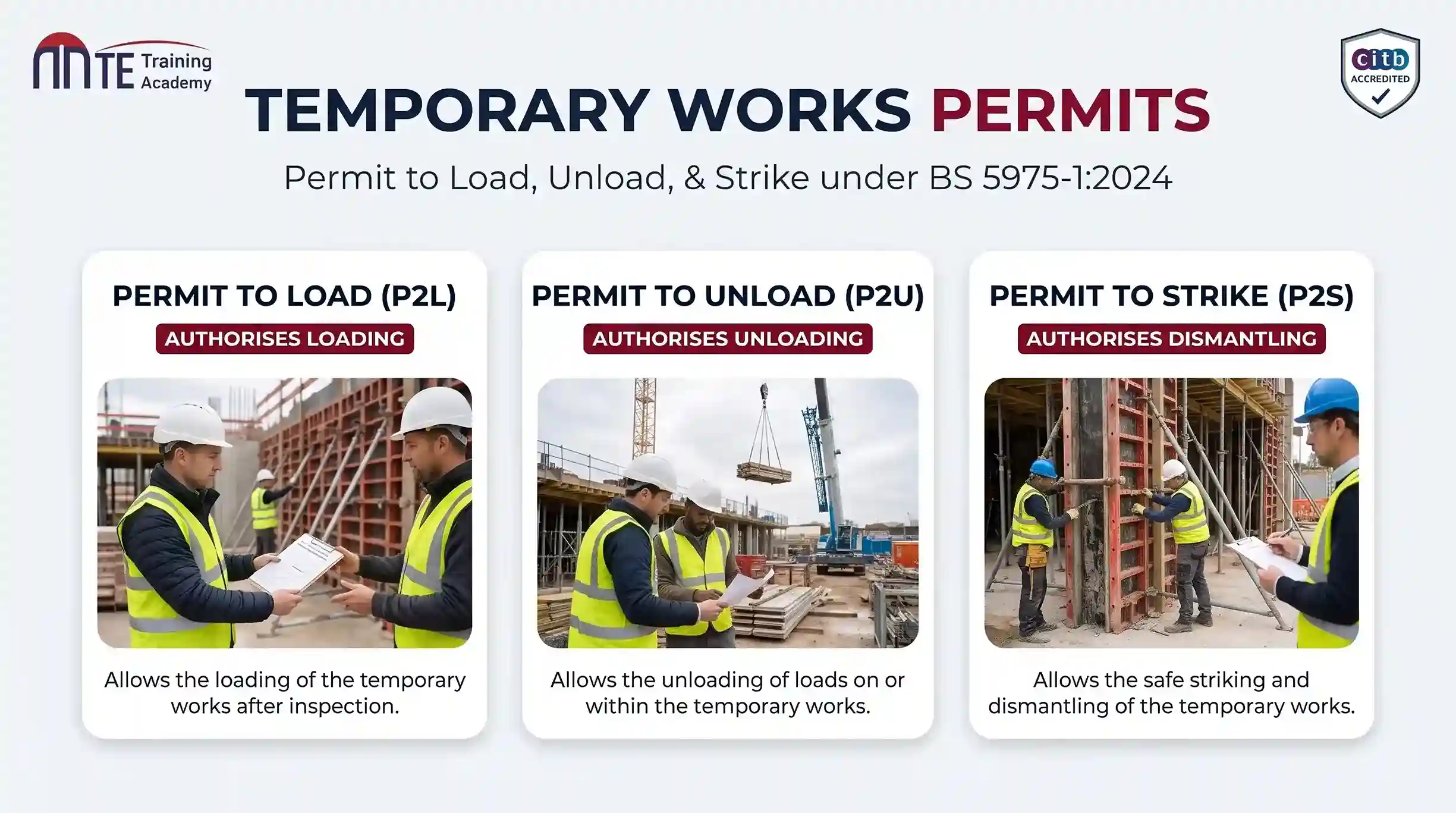
- Permits to Load and Permits to Dismantle (Strike): No temporary works asset should ever be brought into service until physical erection has been inspected against the approved drawings and a formal Permit to Load is signed. Equally, premature striking of falsework or propping before permanent concrete achieves characteristic strength is prevented by enforcing a strict Permit to Dismantle.
5. Design Check Categories (0 to 3) & Independent Verification
A frequent weak spot in the TWCTC-R end-of-course written examination is confusing Implementation Risk Classification with Design Check Categories.
BS 5975-1:2024 mandates that every temporary works design undergoes an independent check for concept, structural adequacy, and compliance with the Design Brief before site erection commences:
| Design Check Category | Scope & Complexity | Who Can Perform the Design Check? | Typical Construction Examples |
|---|---|---|---|
| Category 0 | Standard solutions only (e.g., manufacturer's standard configurations with no structural calculation required). | Another competent member of the site or design team (verifies the standard solution matches actual site conditions). | Proprietary trench boxes used strictly within manufacturer depth tables; standard mobile scaffold towers. |
| Category 1 | Simple designs using established design methods and codes. | Another competent individual within the same design team (independent of the original creator). | Simple propping, standard formwork, shallow excavations under 2m in stable ground, basic hoarding. |
| Category 2 | More complex or involved designs, or novel applications of standard methods. | An individual or team within the same organisation who has had no prior involvement in creating the design. | Complex falsework, deep excavations with high water tables, tower crane bases, significant structural needling. |
| Category 3 | Complex, innovative, high-consequence, or unusual designs. | A completely separate, external organisation independent of the designing company. | Major bridge launch girders, deep cofferdams adjacent to live rail/tunnels, full façade retention on historic structures. |
For engineers working in underground or subterranean environments where Category 2 and Category 3 ground support schemes are routine, we also deliver the specialist CITB Tunnelling Safety Training Scheme (TSTS).
6. How the 1-Day Online TWC Refresher Works (Exam, Cost & Eligibility)
Taking two full days off a live project to repeat the initial course is unnecessary if your existing qualification is still in date. Completing a temporary works co-ordinator refresher course online allows you to renew your CITB Site Safety Plus certification for another five years in a single day from your home or a quiet site office.
Strict Eligibility: The Zero-Grace-Period Rule
To enrol on a temporary works coordinator refresher, you must hold an in-date CITB Temporary Works Co-ordinator (TWCTC) or previous temporary works co-ordinator refresher certificate.
- No Grace Period: CITB retired its historic covid-era extensions years ago. If your current certificate expired even one day before your refresher course date, CITB's automated portal will block your registration, and you will be legally required to sit the full 2-Day CITB Temporary Works Coordinator (TWC) course (£395 +VAT online).
- Site Managers Renewing Multiple Tickets: Many site managers hold both TWC and SMSTS certificates with similar expiry windows. You can schedule your TWC renewal alongside our CITB SMSTS Refresher course to keep your compliance records aligned.
Assessment Format & Pass Mark
At the end of the 1-day citb temporary works coordinator refresher course online, delegates complete the official CITB TWCTC-R open-book examination:
- Duration: 45 minutes.
- Question Breakdown: 22 questions in total, comprising 18 multiple-choice questions (worth 1 mark each) and 4 written-answer questions (worth between 1 and 3 marks each).
- Pass Mark: 78% (21 out of 27 marks), including mandatory safety-critical questions.
- Open-Book Rules: You are permitted to use your official CITB course publication and your personal notes taken during the tutor-led sessions.
- Free Resit Included: Unlike national training brokers who charge £275 to £325 +VAT plus additional re-examination fees, TE Training Academy provides the 1-day live online course for £250.00 +VAT with a Free Resit Available (subject to CITB eligibility criteria).
7. Frequently Asked Questions (TWCTC-R & BS 5975:2024)
Can I take a temporary works coordinator refresher course online?
Yes. CITB fully approves live virtual delivery for the temporary works coordinator refresher course online. You attend a live, interactive 1-day session via Zoom led by an accredited civil engineering instructor, participate in group case studies, and complete your proctored examination online using a laptop or desktop computer with a working webcam and microphone.
What is the difference between a CITB temp works refresher coordinator course and the full 2-day course?
A citb temp works refresher coordinator course (TWCTC-R) condenses the syllabus into one intensive day (£250 +VAT) focused on regulatory updates, specifically the transition to BS 5975-1:2024 and BS 5975-2:2024, alongside advanced coordination case studies. It carries the exact same 5-year CITB Site Safety Plus renewal validity as the 2-day course, provided you attend before your existing certificate expires.
Is the temporary works co ordinator refresher course eligible for the CITB Levy Grant?
Yes. CITB-registered employers who are up to date with their Levy return can claim the Tier 1 short-duration refresher grant (currently £60 per eligible delegate) upon successful completion of our temporary works co ordinator refresher course or temporary works co ordinator refresher course online. Just provide your 7-digit CITB Levy number when booking.
Do I automatically become the site TWC after passing my refresher?
No. Passing the CITB TWCTC-R proves you have updated your theoretical knowledge of BS 5975-1:2024. Under British Standard guidelines, you only have authority to act as a Temporary Works Co-ordinator on a project once your employer's Designated Individual (DI) assesses your experience and signs a formal letter of appointment naming you for that specific project.