

CITB TWC Certificate Expiry: Everything You Need to Know About Renewal Rules
Technical Review: Aligned with BS 5975-1:2024 & CITB SSP Quality Assurance Standards
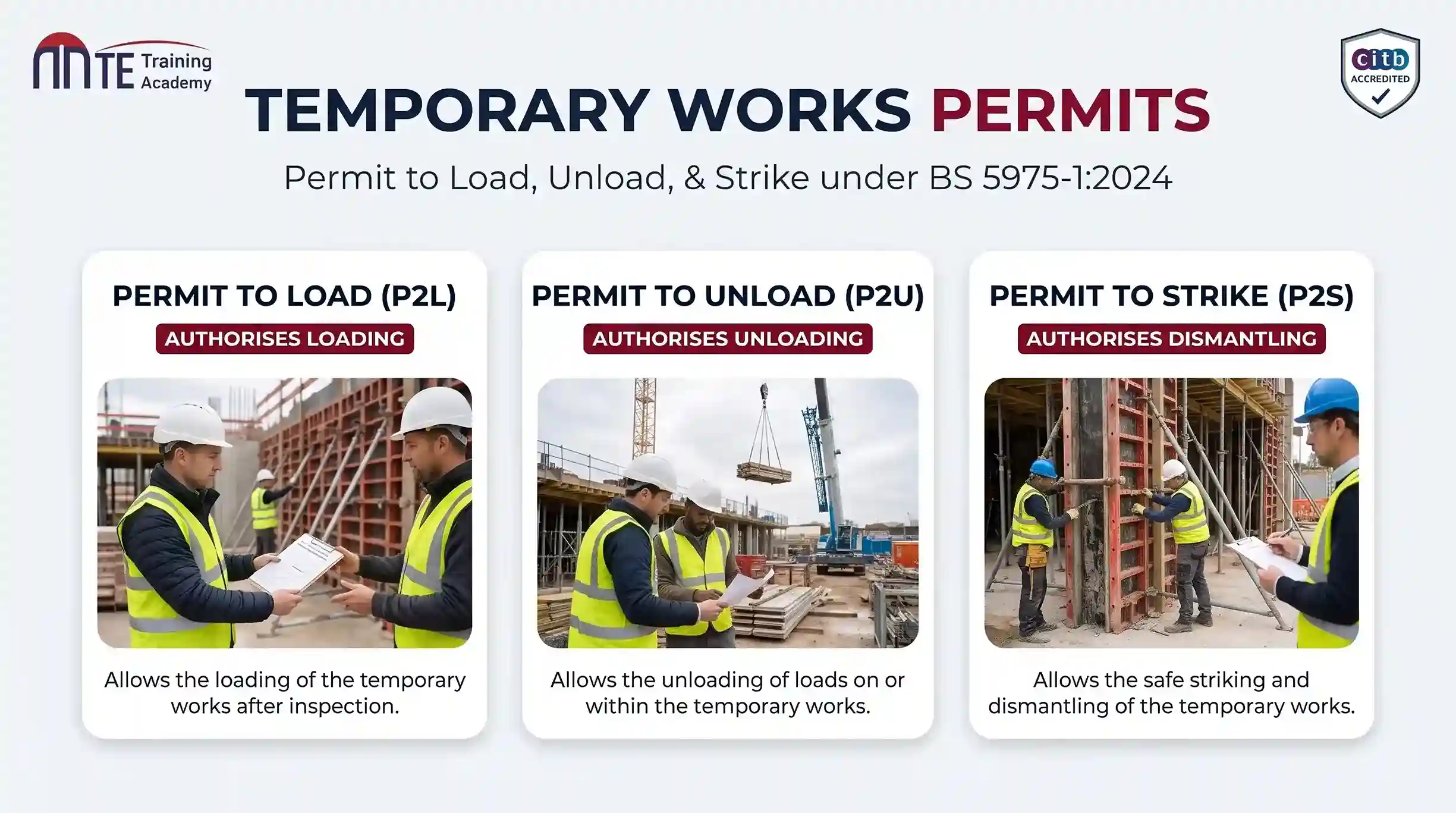
A CITB Temporary Works Coordinator (TWC) certificate is valid for five years from the date you pass your examination. To keep your qualification active under official CITB Temporary Works Coordinator refresher rules, you must attend and pass the one-day Temporary Works Co-ordinator Refresher course (TWCTC-R) before the expiry date printed on your certificate. CITB operates a strict zero-grace-period policy: if your certificate expires by even a single day, you lose eligibility for the refresher route and must complete the full 2-day CITB Temporary Works Coordinator (TWC) course again from scratch.
For Site Managers, Civil Engineers, and Principal Contractors operating on UK construction projects, an unnoticed certificate lapse is more than an administrative headache. It invalidates your formal appointment on site, halts your authority to issue Permits to Load or Strike, and exposes your organisation to compliance breaches under the Construction (Design and Management) Regulations 2015 (CDM 2015).
Below is the complete operational guide to managing your CITB TWC certificate expiry, navigating the transition from the withdrawn BS 5975:2019 standard to BS 5975-1:2024, and choosing the right renewal pathway for your team.
How Long Does a CITB TWC Certificate Last? (The 5-Year Rule)
Every qualification issued under the CITB Site Safety Plus (SSP) scheme, including the Temporary Works Coordinator Training Course (TWCTC), carries a mandatory 5-year validity period.
Your five-year validity is calculated from the month you pass your final multiple-choice assessment, not the date the PDF or physical certificate arrives from Cskills Awards. Certificates generally expire on the last day of the month in which the exam was taken. For example, if your exam date is 10 October 2026, your certification will expire on 31 October 2031.
Why Does CITB Enforce a 5-Year Expiry Cycle?
Unlike an academic civil engineering degree, temporary works coordination is governed by evolving British Standards, Health and Safety Executive (HSE) enforcement priorities, and industry failure data. CITB enforces a five-year revalidation cycle for three practical reasons:
- Major British Standard Revisions: If you qualified in 2021, you were trained under BS 5975:2019. On 31 December 2024, the British Standards Institution (BSI) withdrew the 2019 edition and split the code of practice into two distinct standards: BS 5975-1:2024 (Management procedures) and BS 5975-2:2024 (Falsework design and implementation).
- Preventing Procedural Drift on Site: Over five years of high-pressure programme deadlines, site teams often develop informal shortcuts around Temporary Works Registers, Category 0 to Category 3 design checks, and hold-point inspections.
- Designated Individual (DI) Assurance: Under BS 5975-1:2024, your company's Designated Individual has an ongoing duty to verify that appointed Temporary Works Co-ordinators possess up-to-date procedural knowledge.
What Happens If Your CITB TWC Certificate Expires by One Day?
CITB permanently removed the historic six-month renewal grace period across all Site Safety Plus courses. There are no automatic extensions for holidays, project handovers, or waiting lists.
If you hold an expired TWCTC certificate, two immediate consequences apply:
- Training Consequence: Training providers are blocked by the CITB portal from registering your delegate profile onto a 1-day Refresher (TWCTC-R) course once your expiry date has passed. To regain your Cskills Awards certification, you must sit and pass the full accredited 2-day CITB TWC course.
- Site Compliance Consequence: While BS 5975-1:2024 states that competency is a combination of skills, knowledge, experience, and training (commonly referred to as SKET), virtually all UK Tier 1 Principal Contractors mandate an in-date CITB TWCTC certificate as a baseline condition of appointment. Signing off a Permit to Load with a lapsed certificate can void contractor insurance protocols and trigger an immediate site audit non-conformance.
Are Medical or Extenuating Circumstances Exemptions Available?
CITB grants discretionary extensions only in exceptional, documented circumstances, such as serious long-term illness, bereavement, or statutory parental leave, and the application must be submitted directly to CITB before the expiry of the existing certificate, accompanied by supporting evidence. Heavy site workloads or employer booking delays are never accepted by CITB as grounds for an exemption.
Full 2-Day TWCTC vs. 1-Day TWCTC-R Refresher: Side-by-Side Comparison
Even when a delegate is still within their five-year validity window, many Designated Individuals and H&S Directors choose to put their coordinators back through the full 2-day course rather than the 1-day refresher, especially if the coordinator has not actively managed complex temporary works over the past two years.
Use this comparison table to decide whether to book the 1-day Refresher or the full 2-day course:
| Feature / Requirement | 2-Day Full Course (TWCTC) | 1-Day Refresher (TWCTC-R) |
|---|---|---|
| Course Duration | 2 Days (minimum 14 hours plus exam ) | 1 Day (minimum 7 hours ) |
| Entry Prerequisite | None (Experience in construction/temporary works recommended) | Mandatory in-date CITB TWCTC or TWCTC-R certificate |
| Eligibility After Expiry | Eligible at any time | Not eligible once expiry date passes |
| Core Syllabus Focus | Complete BS 5975-1:2024 procedures, the 4 Cs, Bragg Report, CDM 2015, risk registers, and design briefs from first principles | Condensed update on BS 5975-1:2024 changes, recent HSE enforcement trends, and common audit failures |
| Final Assessment | 18 multiple choice + 4 mandatory text/scenario questions (Open-book window included, 78% pass mark) | 18 multiple choice + 4 mandatory text/scenario questions (Open-book window included, 78% pass mark) |
| Certificate Validity | 5 Years | 5 Years |
| Best Suited For | First-time TWCs, delegates with expired certificates, or managers wanting a thorough BS 5975-1:2024 grounding | Active TWCs renewing before the expiry of their current certification |
(Unsure whether your site staff actually need the Coordinator qualification or the 1-day Supervisor course instead? Read our companion breakdown on CITB TWCTC vs. TWSTC: Coordinator vs. Supervisor to match the right course to their site duties.)
Major BS 5975-1:2024 Updates You Must Know Before Renewing in 2026
If you last completed your Temporary Works Co-ordinator training between 2020 and 2024, your course textbook and examination were based on BS 5975:2019.
On 31 December 2024, BSI withdrew BS 5975:2019 and replaced it with a two-part standard. Whether you renew via the 1-day refresher or retake the CITB Temporary Works Coordinator training course, your 2026 assessment will test your understanding of five critical changes introduced in BS 5975-1:2024:
1. The Split Into Part 1 and Part 2
Previously, management procedures and falsework engineering calculations lived inside a single, bulky document. The standard is now divided into:
- BS 5975-1:2024 (Management procedures for the control of temporary works): Contains Sections 1 and 2 of the old standard. This is the primary reference document for Temporary Works Co-ordinators, Temporary Works Supervisors, and Designated Individuals.
- BS 5975-2:2024 (Falsework: Design and implementation): Contains the revised Section 3 engineering rules for falsework, introducing a new Clause 8 covering limit state design with partial load factors alongside permissible stress methods.
2. Tighter Integration With the Principal Designer (CDM 2015)
BS 5975-1:2024 places far stronger emphasis on how the Temporary Works Co-ordinator interfaces with the Principal Designer (PD) and Permanent Works Designer under CDM 2015. Coordinators must ensure design risk information flows bi-directionally, particularly where temporary propping, excavation shoring, or tower crane grillages impose loads on the permanent structure.
3. New Environmental Risk Controls
In response to extreme weather events impacting UK construction sites, BS 5975-1:2024 introduces explicit guidance on assessing environmental hazards in the Temporary Works Design Brief. As a TWC, you are expected to account for flash flooding, high-wind overturning on hoardings and scaffolding, groundwater fluctuations, and soil erosion during excavation works.
4. Stricter Independence in Design Check Categories (Categories 0 to 3)
The 2024 revision sharpens the definitions around what constitutes true independence across Design Check Categories 0, 1, 2, and 3:
| Category | Complexity Scope | Required Independence Level Under BS 5975-1:2024 |
|---|---|---|
| Category 0 | Standard solutions only (e.g., proprietary trench boxes used within manufacturer depth ratings, TG20 compliant standard scaffolds) | Checked by another member of the site or design team to verify the standard solution applies to site conditions. |
| Category 1 | Simple designs (e.g., standard formwork, simple falsework, routine hoarding foundations) | Checked by another person within the same design team who was not involved in originating the calculation. |
| Category 2 | More complex or innovative designs (e.g., deep sheet-piled excavations, facade retention, heavy crane working platforms) | Checked by an individual in a separate team or division not consulted during the original design creation. |
| Category 3 | Complex, high-risk, or novel structures (e.g., major bridge launch falsework, deep subterranean tunnelling supports) | Checked by a completely independent organisation with zero prior involvement in the project design. |
(For a deeper technical walkthrough of each clause, bookmark our upcoming guide on BS 5975 Explained: The Ultimate Guide to Temporary Works Procedures.)
How to Check Your CITB TWC Expiry Date Online (3-Step Verification)
If you cannot locate your original Cskills Awards PDF certificate, do not guess your renewal deadline. Verify your exact expiry date in under two minutes using the official CITB online card checker:
- Search the CITB Construction Training Register (CTR): Visit the official CITB Construction Training Register online portal. Enter your CITB Registration Number (also printed on your CSCS card) or your full legal name and date of birth.
- Inspect the Courses Qualification Tab: Locate the entry titled Temporary Works Co-ordinator Training Course (TWCTC) or Temporary Works Co-ordinator Refresher (TWCTC-R). Check the exact Expiry Date column.
- Request a Duplicate Certificate via Your Original Provider (Chargeable, If Needed): When booking a refresher course, your training provider must verify your existing qualification number on the CITB portal. Keep a screenshot of your CTR record and your CITB HSPD/Registration ID ready before booking.
The Optimal Timeline for Renewing Your TWC Qualification
To avoid the trap of an expired certificate and forced 2-day re-enrolment, follow this 90-day renewal schedule used by Tier 1 H&S training managers:
- 90 Days Before Expiry: Audit your company's training matrix and verify every TWC's registration number on the CITB Construction Training Register.
- 60 Days Before Expiry: Book your delegate onto a scheduled course date. Booking two months in advance protects you if a delegate falls ill on the day of training or if a course date is rescheduled, leaving plenty of buffer time before the five-year cutoff.
- 30 Days Before Expiry: Review your company's internal Temporary Works Procedure document alongside the latest BS 5975-1:2024 terminology so you arrive at your exam familiar with updated definitions. (Check out our guide on How to Pass the CITB TWC Exam First Time for open-book revision tactics.)
- Post-Course Action: Once your renewed certificate is issued, ask your Designated Individual (DI) to update your formal TWC Appointment Letter and log the new five-year expiry date on the project's Temporary Works Register.
Frequently Asked Questions: CITB TWC Renewal & Expiry
Technically, BS 5975-1:2024 does not mandate a specific training board certificate by law; it requires the Designated Individual to appoint a competent person based on skills, knowledge, experience, and training. However, in practice across the UK construction sector, Principal Contractors, insurers, and Build UK standards treat an in-date CITB TWCTC certificate as mandatory evidence of current training. Allowing your certificate to expire will almost certainly result in your site appointment being suspended until you re-qualify.
No. The Site Management Safety Training Scheme (SMSTS) and the Temporary Works Co-ordinator Training Course (TWCTC) are entirely separate CITB Site Safety Plus qualifications with independent five-year expiry dates. Passing an SMSTS Refresher does not extend or revalidate your TWC status.
Secure Your CITB TWC Qualification With TE Training Academy
Whether your 5-year certificate has recently lapsed or you are qualifying new Site Engineers and Project Managers under the latest BS 5975-1:2024 code of practice, delaying your booking puts your site handovers and permit procedures at risk.
At TE Training Academy, our CITB-accredited tutors bring decades of real-world civil, structural, and tunnel engineering experience directly into the classroom, ensuring your team doesn't just pass the exam, but knows how to prevent costly temporary works failures on site.