

Temporary Works Coordinator (TWC) Salary, Duties & Career Path in the UK (2026 Guide)
Standards Referenced: BS 5975, CDM Regulations 2015, CITB Site Safety Plus
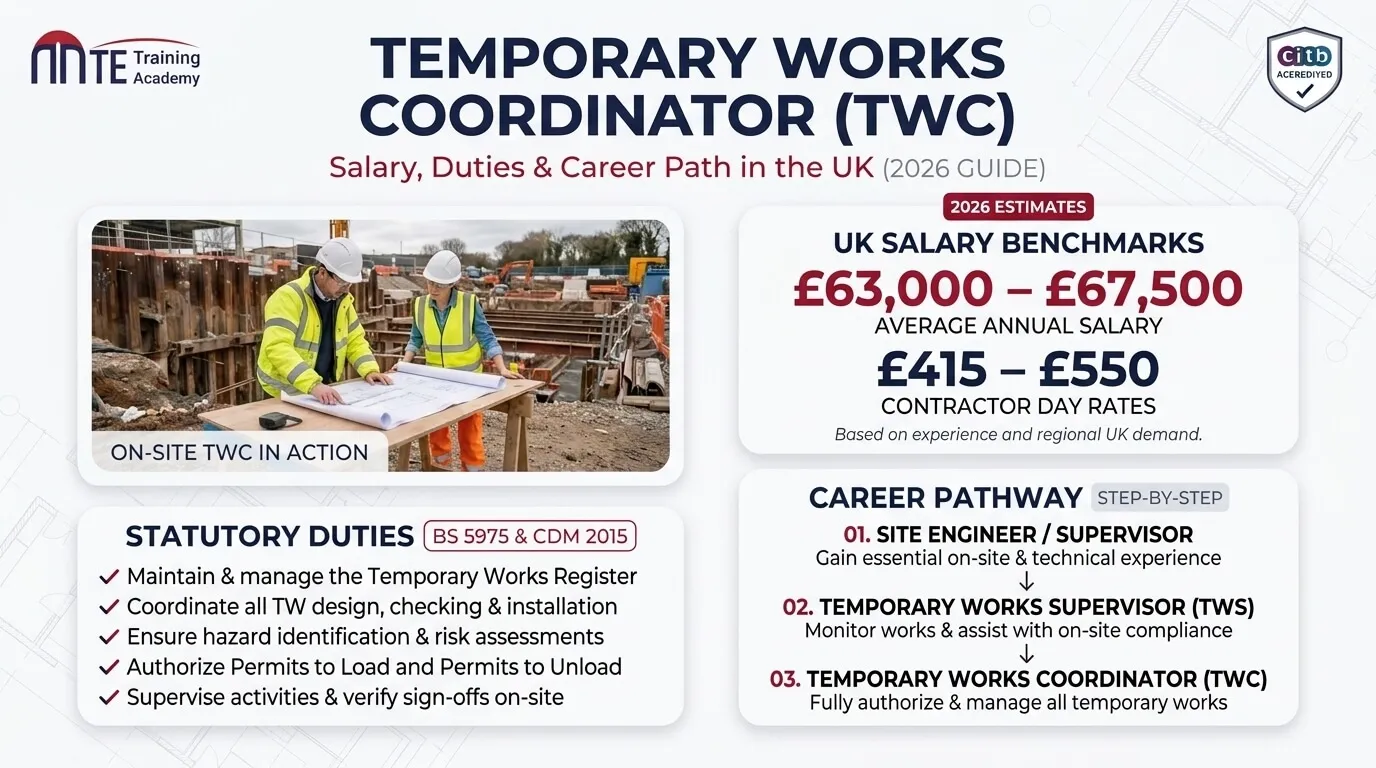
A qualified Temporary Works Coordinator (TWC) in the UK earns an average permanent salary of £63,000 to £67,500 per year, while freelance coordinators command day rates between £415 and £550. Driven by strict enforcement of the BS 5975 Code of Practice and major UK infrastructure investment, the TWC role has become one of the most lucrative and resilient compliance pathways for Site Engineers, Site Managers, and Civil Supervisors.
Whether you are a Site Agent asked by a Tier 1 Principal Contractor to take on temporary works responsibility, or a civil engineer looking to increase your freelance day rate, understanding how the role operates on site is essential. This guide breaks down UK remuneration benchmarks, statutory BS 5975 duties, the step-by-step qualification pathway.
What is a Temporary Works Coordinator (TWC)?
A Temporary Works Coordinator (TWC) is the competent person formally appointed on a construction project to manage, coordinate, and oversee all temporary works procedures from initial concept through to final dismantling. Rather than designing the structures themselves, the TWC acts as the central point of procedural control under BS 5975 (the British Standard Code of Practice for Temporary Works Procedures and the Permissible Stress Design of Falsework).
On any active UK construction site, "temporary works" encompasses every engineered solution required to enable permanent works to be built or to support existing structures during modification. Common examples include:
- Earthworks and Geotechnical Support: Trench shoring, sheet piling, cofferdams, and battered excavations.
- Formwork and Falsework: Concrete shutters, slab propping, and backpropping systems.
- Structural Stabilization: Facade retention frames, structural needling, and temporary roof systems.
- Plant Foundations and Access: Tower crane bases, mobile crane outrigger mats, piling platforms, haul roads, and complex scaffolding outside standard NASC TG20 compliance.
Because structural failure in any of these elements can result in catastrophic collapse, Tier 1 and Tier 2 contractors require individuals managing the process to complete the accredited CITB Temporary Works Coordinator (TWC) course before being formally appointed on site.
Temporary Works Coordinator Salary UK & Freelance Day Rates (2026 Data)
Compensation for a Temporary Works Coordinator varies significantly depending on whether you perform the duties as a standalone, full-time specialist on a major civil infrastructure scheme or as a dual-hatted Site Manager / Site Engineer carrying TWC responsibilities alongside daily operational duties.
According to October 2026 UK construction recruitment data from Totaljobs, Reed, and ContractorUK, the national average salary for a dedicated Temporary Works Coordinator sits between £63,178 and £67,499 per annum.
UK TWC Salary & Day Rate Breakdown by Seniority
| Role / Experience Level | Typical Permanent Salary (UK) | Freelance Day Rate (Inside / Outside IR35) | Typical Project Scope |
|---|---|---|---|
| Assistant / Junior Site Engineer (with TWC) | £38,000 – £46,000 | £280 – £340 / day | Residential developments, minor commercial refurbishments (Category 0–1 checks) |
| Dual-Role Site Manager / Agent (with TWC) | £52,000 – £62,000 | £350 – £420 / day | Medium-scale commercial build, regional civil engineering, D&B contracts |
| Dedicated Project TWC | £63,000 – £74,000 | £430 – £500 / day | Major highways, water treatment, rail infrastructure, high-rise RC frames (Category 2 checks) |
| Senior / Group Temporary Works Manager | £75,000 – £92,000+ | £510 – £600+ / day | Tier 1 mega-projects (nuclear, HS2, tunnelling, complex demolition, Category 3 checks) |
Regional & Sector Pay Multipliers
- London & The South East: Permanent TWC salaries in Greater London and major commuter corridors command a 12% to 18% premium, frequently including a £5,000–£7,500 car allowance, private healthcare, and performance bonuses.
- Major Infrastructure, Energy & Rail: Projects governed by Network Rail, National Highways, or nuclear site licences require rigorous Category 2 and Category 3 independent design checks. Freelance TWCs with civil or structural engineering degrees working in these sectors regularly achieve £450 to £550 per day.
- The "Dual-Hat" Salary Uplift: For existing Site Managers, Sub-Agents, and Senior Engineers, adding the CITB TWCTC qualification to an existing SMSTS or engineering degree typically adds £4,000 to £8,000 in annual market value, and often serves as a mandatory gateway for promotion to Project Manager.
Core Daily Responsibilities: Temporary Works Coordinator Job Description
A common misconception among site staff is that the Temporary Works Coordinator has to calculate structural loads. Under BS 5975, the TWC is not normally the designer; instead, the TWC is the procedural gatekeeper who ensures that every piece of temporary works is properly briefed, designed, checked, erected, inspected, and dismantled around the 4 Cs: Communication, Cooperation, Coordination, and Competency.
If you are applying for a TWC role or stepping into the appointment on your current project, your daily job description will centre on seven core duties:
- Establishing and Maintaining the Temporary Works Register: Before construction begins, the TWC collaborates with the project team to identify all foreseeable temporary works items and logs them into a live Temporary Works Register. This tracks risk classifications, design status, check categories, and permit dates.
- Preparing Comprehensive Design Briefs: A design is only as safe as the information given to the engineer. The TWC compiles the Temporary Works Design Brief, supplying the Temporary Works Designer (TWD) with accurate site investigation reports, soil bearing pressures, adjacent structural constraints, concrete pour rates, and construction sequences.
- Assigning Design Check Categories (Categories 0 to 3): Using the guidance in BS 5975, the TWC ensures every design undergoes an independent check matching its complexity and risk:
- Category 0: Standard solutions (e.g., proprietary trench boxes used within manufacturer tables) checked inside the site team.
- Category 1: Simple designs (e.g., standard formwork or simple propping) checked by another competent engineer within the same organisation.
- Category 2: More complex or innovative designs (e.g., deep basements, crane grillages) checked by an independent engineer not involved in the original design.
- Category 3: Complex, high-risk, or novel structures (e.g., major bridge falsework or heavy facade retention) checked by a completely separate, external engineering consultancy.
- Coordinating Interfaces with Permanent Works: Under the CDM Regulations 2015, temporary works frequently impose loads on permanent structures, such as backpropping freshly poured concrete slabs or tying a scaffold into a masonry facade. The TWC coordinates with the Principal Designer and Permanent Works Designer to prevent overstressing the permanent structure.
- Appointing and Directing Temporary Works Supervisors (TWS): On larger sites, the TWC delegates physical, on-the-ground inspections to qualified Temporary Works Supervisors (TWSTC). While the TWS assists with daily checks, overall procedural accountability always remains with the TWC.
- Managing Hold Points and Issuing Formal Permits: Ensure zero unauthorised loading takes place. Once the Temporary Works Erector completes installation and the equipment is inspected against the certified drawings, the TWC issues a formal Permit to Load (or Permit to Proceed). When the permanent works become self-supporting, the TWC verifies curing data (such as concrete cube test results) and issues a Permit to Strike (Dismantle).
- Controlling On-Site Variations: When site conditions differ from the drawings (for instance, encountering unexpected soft ground under a piling rig platform), the TWC halts operations and refers the change back to the Temporary Works Designer for formal re-approval.
Step-by-Step Career Path: How to Become an Appointed TWC
Passing a training course alone does not automatically make you a Temporary Works Coordinator on a UK construction site. Both the Health and Safety Executive (HSE) and the Temporary Works Forum (TWf) emphasise that competence equals Training + Experience + Formal Appointment.
Follow this four-step career pathway to become a fully recognised TWC:
Step 1: Build Foundational Site Engineering or Management Experience
Most candidates enter the temporary works pathway from one of two backgrounds:
- The Engineering Route: Graduate Civil/Structural Engineers, Setting Out Engineers, Section Engineers, and Sub-Agents who read structural drawings and manage subcontractors daily.
- The Site Management Route: Experienced Foremen, Works Managers, and Site Managers who already hold SSSTS or SMSTS qualifications and understand UK statutory safety frameworks (Health and Safety at Work etc. Act 1974 and CDM 2015).
Step 2: Complete the 2-Day CITB Temporary Works Coordinator Course (TWCTC)
To meet the training pillar required by UK Principal Contractors, you must complete the official 2-day CITB Site Safety Plus Temporary Works Coordinator Training Course (TWCTC). During the course, you will work through real-world collapse case studies, set up registers, audit design briefs, and sit the CITB TWC open-book examination, which consists of 22 multiple-choice questions and 3 mandatory safety-critical questions.
Take the next step in your civil engineering or site management career by enrolling in our CITB-levy eligible Temporary Works Coordinator (TWCTC) training.
Step 3: Receive Formal Written Appointment from the Designated Individual (DI)
Every construction organisation managing temporary works must have a senior director or leader acting as the Designated Individual (DI) under BS 5975. Once you hold your CITB TWCTC certificate, your company's DI (or the Principal Contractor's DI) will assess your relevant site experience against the complexity of the project and issue a formal TWC Appointment Letter. You must sign this letter to accept the scope of authority for that specific site.
Step 4: Progress to Senior TWC or Designated Individual (DI) & Maintain Compliance
Your CITB TWC certificate is valid for 5 years. Before it expires, you must complete the 1-day CITB TWC Refresher course (TWCTC-R) to remain compliant. Over time, coordinators managing Category 2 and Category 3 infrastructure schemes often progress into Group Temporary Works Manager roles, chartership with the Institution of Civil Engineers (ICE) or CIOB, or step up as a company's Designated Individual (DI).
TWC vs. Other Site Roles: Where Does the Coordinator Fit?
Understanding how the TWC interacts with other statutory roles prevents dangerous gaps in site accountability:
| Role Title | Primary Responsibility in Temporary Works | Typical Qualification Required | Signs Off "Permit to Load"? |
|---|---|---|---|
| Designated Individual (DI) | Board/Director-level person who establishes the company's overall temporary works policy and assesses TWC competence. | Senior Engineering / Director background + DI Awareness | No (Appoints the TWC) |
| Temporary Works Coordinator (TWC) | Manages the end-to-end BS 5975 procedure, maintains the register, briefs designers, and authorises loading/striking. | 2-Day CITB TWCTC + Relevant Site Experience | Yes |
| Temporary Works Supervisor (TWS) | Assists the TWC on site by inspecting physical erection, use, and dismantling against approved drawings. | 1-Day CITB TWSTC | Only if specifically delegated in writing for low-risk items |
| Temporary Works Designer (TWD) | Calculates structural loads, produces drawings, specifies materials, and identifies residual dismantling hazards. | Civil/Structural Engineering Degree (BEng/MEng, CEng) | No (Issues Design Certificate) |
| Site Manager (SMSTS Holder) | Overall site health, safety, welfare, and programme delivery under CDM 2015. | 5-Day CITB SMSTS | Not unless also appointed as TWC/TWS |
Frequently Asked Questions (FAQs)
No, a formal civil or structural engineering degree is not mandatory to attend the CITB TWCTC course or be appointed as a TWC on low-to-medium complexity sites. Experienced Site Managers, Site Agents, and Foremen regularly qualify and act as TWCs on residential and commercial build projects, provided they have strong knowledge of construction methods and access to competent Temporary Works Designers for engineering calculations. Major civil infrastructure sites (Category 2 and 3) typically prefer TWCs with a HNC/HND or degree in civil engineering.
No. Passing the 2-day CITB TWCTC course proves you have completed nationally recognised training in BS 5975 procedures. However, to act as a TWC on site, you must also be formally appointed in writing by your organisation's Designated Individual (DI) after they verify your practical experience matches the project's risk profile.
Yes. On small-to-medium construction projects, it is common practice for the Site Manager or Project Manager to be "dual-hatted", holding both a CITB SMSTS certificate and a CITB TWC qualification. On large or high-risk civil engineering schemes, BS 5975 recommends appointing a dedicated TWC whose sole focus is temporary works compliance.
The CITB TWCTC certificate is valid for 5 years. To maintain your qualification without retaking the full 2-day course, you must pass the 1-day Temporary Works Coordinator Refresher (TWCTC-R) before your existing certificate expires.
Ready to Qualify as a CITB Temporary Works Coordinator?
Whether you are an individual professional looking to command a higher salary or an employer ensuring full BS 5975 compliance across your projects, TE Training Academy delivers interactive, tutor-led training designed for high first-time pass rates.