

CDM 2015 Temporary Works Duties & The Bragg Report: The Legal Liabilities of Temporary Works Explained
Reviewed against: CDM 2015, HSWA 1974, and BS 5975-1:2024 / BS 5975-2:2024
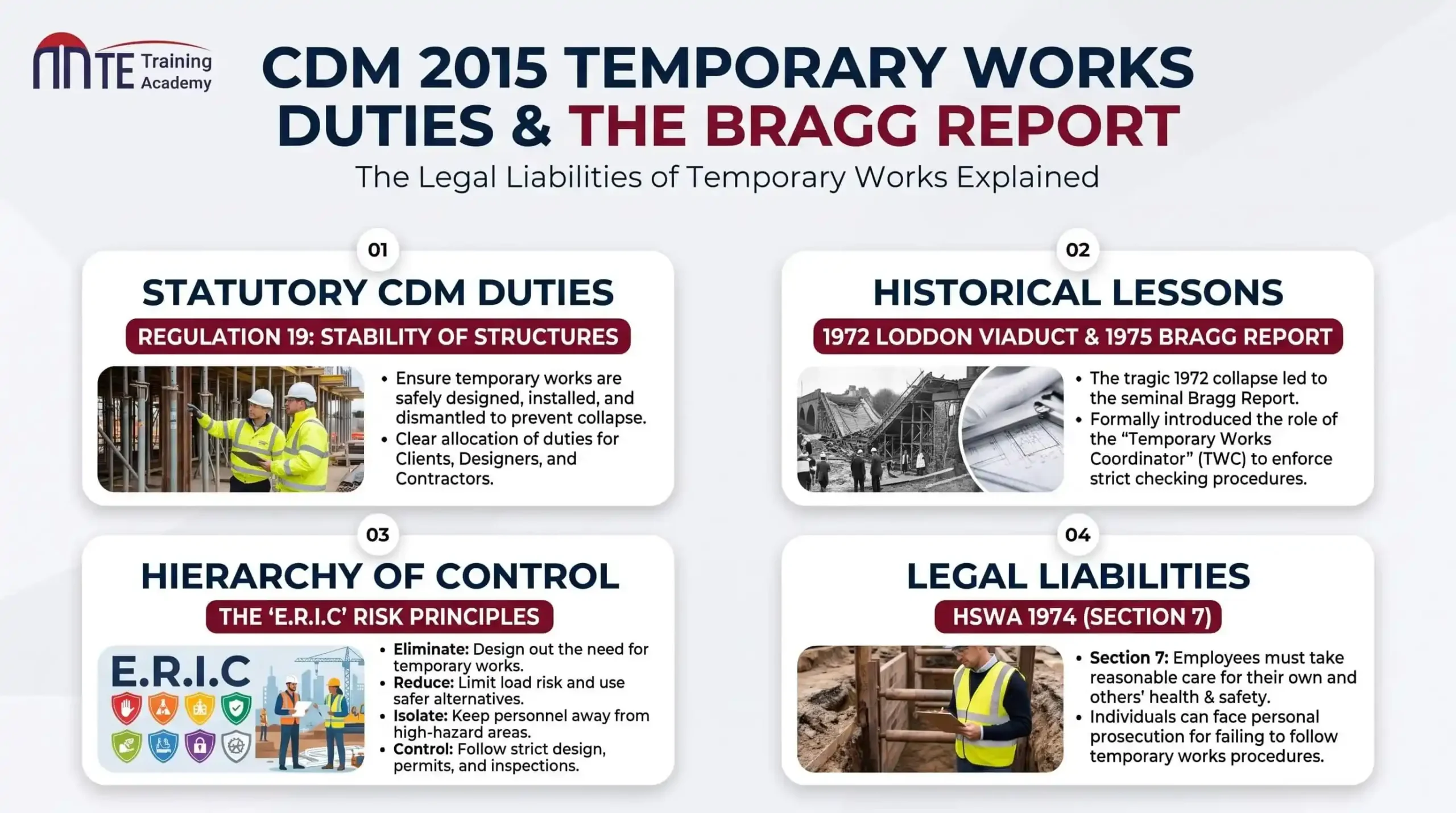
Understanding CDM 2015 temporary works duties is essential for every Principal Contractor, Site Manager, and Civil Engineer operating in the UK construction sector. Whilst British Standard BS 5975 (recently updated to BS 5975-1:2024 and BS 5975-2:2024) outlines the procedural code of practice for appointing a Temporary Works Coordinator (TWC), the underlying criminal liability for temporary works sits squarely within the Construction (Design and Management) Regulations 2015 (CDM 2015) and the Health and Safety at Work etc. Act 1974.
On Day 1 of our 2-day CITB Temporary Works Coordinator (TWC) course, one question arises from delegates more than any other: "If a scaffold, trench support, or falsework system fails on my site, am I personally liable to be prosecuted by the Health and Safety Executive (HSE)?"
This guide breaks down why the 1975 Bragg Report created the modern TWC role, how CDM 2015 allocates statutory duties across project teams, how to apply the ERIC hierarchy of risk control, and where personal and corporate legal liability truly lies.
1. Why Do We Have Temporary Works Procedures? The 1972 Loddon Viaduct Collapse
To understand why the Temporary Works Coordinator role exists, you must look back to 24 October 1972. During the construction of the A329(M) motorway relief road in Woodley, near Reading, Berkshire, a 28-metre (93-foot) span of the Loddon Viaduct was being poured with wet concrete over the River Loddon.
In August 1972, the steel falsework system, comprising steel lattice trusses resting on a two-layer grillage of universal I-beams and 7.3-metre Indumat trestle towers, had been successfully used to cast the westbound carriageway. Rather than dismantling and re-erecting the falsework for the eastbound carriageway, the contractor slid the entire assembly across on a temporary track.
Despite questions raised on site regarding whether the towers remained truly plumb, the concrete pour proceeded. Seconds into the pour, horizontal forces and eccentric loading caused the unstiffened steel grillage beams to buckle. The entire falsework structure and wet concrete deck plunged into the river below, killing three construction workers and injuring ten others (seven seriously).
Why the Loddon Bridge Collapse Changed UK Law Forever
Under the outdated Factories Act 1961, the contractor (Marples Ridgway) pleaded guilty and received a fine of just £150 plus £150 in court costs. Outrage over the human cost and a string of global falsework disasters (including the Birling Road overbridge collapse in Kent and the Koblenz Bridge collapse in Germany) prompted the UK Government to appoint an independent Advisory Committee on Falsework in 1973, chaired by physicist and engineer Stephen Lawrence Bragg.
2. The 1975 Bragg Report: 6 Recommendations That Reshaped UK Construction
Published in 1975 (shortly after the enactment of the Health and Safety at Work etc. Act 1974), the final Bragg Report revealed a systemic flaw in UK civil engineering: permanent structures were meticulously engineered and checked, whereas temporary structures supporting the exact same loads were left to informal site custom, "rule of thumb" guesses, and fragmented communication.
The Bragg Report temporary works investigation established six foundational principles that directly created BS 5975 (first published in 1982 and updated to BS 5975-1:2024 and BS 5975-2:2024):
- 1. Appointment of a Temporary Works Coordinator (TWC): Every site must have a formally appointed individual responsible for ensuring that all temporary works procedures are followed from design brief through to dismantling.
- 2. Elimination of "Rule of Thumb" Installations: All falsework and temporary structures must be engineered against a formal Temporary Works Design Brief, accounting for construction tolerances, eccentricity, and reused material strengths.
- 3. Mandatory Allowance for Horizontal Loads: Because the Loddon Viaduct failed via lateral instability and web buckling, Bragg recommended that all falsework be designed to resist calculated lateral forces plus a minimum notional horizontal load (equal to 1% to 3% of the vertical load).
- 4. Independent Design Checking: Designs must undergo documented verification (now codified as Categories 0, 1, 2, and 3 in BS 5975-1:2024) to prevent calculation blind spots.
- 5. Formal Hold Points (Permits to Load and Strike): No temporary structure may be loaded with concrete or plant, nor struck (dismantled), without a documented physical inspection and written authorisation.
- 6. National Competency Training: The committee recommended introducing a standardised national training scheme overseen by the CITB and HSE so site personnel understand soil mechanics, structural stability, and procedural control.
Need to qualify your site management or engineering team? View live dates, CITB grant eligibility, and instant booking on our accredited CITB Temporary Works Coordinator (TWC) course page.
3. CDM 2015 Temporary Works Duties: Who Is Legally Responsible?
A common trap in construction compliance is searching the Construction (Design and Management) Regulations 2015 (CDM 2015) for the phrase "Temporary Works Coordinator". You will not find the title "TWC" anywhere in the text of CDM 2015.
Why? Because CDM 2015 sets out statutory duty holders (Clients, Principal Designers, Designers, Principal Contractors, and Contractors), whereas BS 5975-1:2024 provides the industry-accepted management mechanism for discharging those statutory duties on site.
The Crucial Link: CDM 2015 Regulation 19 (Stability of Structures)
Under Part 4 of CDM 2015, specific regulations govern the physical execution of temporary works on every UK construction project:
- Regulation 19 (Stability of structures): Mandates that all practicable steps must be taken to prevent danger to any person, ensuring no new or existing structure becomes unstable or exists in a temporary state of weakness or instability during construction, alteration, or demolition. Any buttress, temporary support, or temporary structure must be of sufficient strength and quality, and must only be erected or dismantled under the supervision of a competent person.
- Regulation 22 (Excavations): Requires that all practicable steps are taken to prevent any excavation or part of an excavation from collapsing, including installing suitable shoring or trench support before workers enter.
- Regulation 20 (Demolition or dismantling): Requires demolition and dismantling sequences (including the striking of falsework, propping, and facade retention) to be planned, recorded in writing before work begins, and supervised by a competent person.
Comparison Table: CDM 2015 Duty Holders vs. BS 5975-1:2024 Roles
To pass both an HSE site inspection and a Tier 1 contractor audit, you must understand how statutory CDM 2015 temporary works duties map onto BS 5975-1:2024 functional roles:
| Role / Title | Governed By | Core Temporary Works Responsibility | Statutory / Legal Status |
|---|---|---|---|
| Client (Commercial) | CDM 2015 (Regs 4–5) | Provide Pre-Construction Information (PCI), such as buried utilities, ground surveys, and structural drawings, and allocate sufficient time and resources. | Statutory Duty Holder (Criminal liability for breach) |
| Principal Designer (PD) | CDM 2015 (Regs 11–12) | Plan, manage, monitor, and coordinate health and safety in the pre-construction phase, ensuring permanent and temporary works design interfaces are coordinated. | Statutory Duty Holder (Criminal liability for breach) |
| Temporary Works Designer (TWD) | CDM 2015 (Reg 9) & BS 5975-1:2024 | Eliminate foreseeable risks in the temporary works design; reduce remaining risks; provide design drawings, loading limitations, and erection/striking sequences. | Statutory Duty Holder under CDM Reg 9 ("Designer" includes temporary works) |
| Principal Contractor (PC) | CDM 2015 (Regs 12–14) | Plan, manage, monitor, and coordinate the construction phase; establish the Construction Phase Plan (CPP); prevent unauthorised site access and structural instability. | Statutory Duty Holder (Primary corporate target in HSE prosecutions) |
| Designated Individual (DI) | BS 5975-1:2024 | Senior director or manager who establishes, audits, and maintains the organisation's corporate Temporary Works Procedure and authorises TWC appointments. | Functional Corporate Role (Often carries statutory liability as a Director under HSWA Section 37) |
| Temporary Works Coordinator (TWC) | BS 5975-1:2024 (Clause 10) | Coordinate all temporary works on site; maintain the Temporary Works Register; issue Design Briefs; verify design checks (Cat 0–3); issue Permits to Load/Strike. | Functional Procedural Role (Discharges the PC's CDM Reg 13 & Reg 19 duties; bound by HSWA Sec 7) |
| Temporary Works Supervisor (TWS) | BS 5975-1:2024 | Assist the TWC on site by physically supervising the erection, alteration, maintenance, and dismantling of temporary works against checked drawings. | Functional Supervisory Role (Discharges "competent supervision" under CDM Reg 19(3)) |
If your site team includes foremen or engineers who inspect physical installations on the ground on behalf of the TWC, they should complete the 1-day CITB Temporary Works Supervisor (TWS) training course to ensure seamless compliance between site operations and management coordination.
4. Is BS 5975-1:2024 Legally Binding in a UK Court?
Strictly speaking, British Standards (including BS 5975-1:2024 and BS 5975-2:2024) are voluntary codes of practice, not Acts of Parliament or Statutory Instruments. However, treating BS 5975 as "optional" is a catastrophic legal mistake.
When the Health and Safety Executive (HSE) investigates a site incident or conducts an unannounced inspection, inspectors assess whether the Principal Contractor has reduced risk "so far as is reasonably practicable" (SFAIRP) under the Health and Safety at Work etc. Act 1974 and complied with CDM 2015 Regulation 13 and Regulation 19.
Because BS 5975-1:2024 is recognised by the HSE, the Temporary Works Forum (TWf), and the UK judiciary as the benchmark industry standard for managing temporary works, failing to follow BS 5975 is treated by the courts as strong prima facie evidence of failing to meet your statutory duties under CDM 2015. Unless a contractor can prove in court that they operated an alternative management system that was equally or more rigorous than BS 5975-1:2024, an HSE prosecution will almost certainly succeed.
(Note: For a deeper technical breakdown of how the 2024 split between Part 1 Management Procedures and Part 2 Falsework Design works in practice, read our companion guide on BS 5975 Explained: The Ultimate Guide to Temporary Works Procedures.)
5. Applying the ERIC Hierarchy of Risk Control to Temporary Works
Under CDM 2015 Regulation 9(2) and the Management of Health and Safety at Work Regulations 1999 (Schedule 1: General Principles of Prevention), both Permanent Works Designers and Temporary Works Designers must apply the ERIC (also taught as ERICPD) hierarchy of risk control.
During the CITB Temporary Works Coordinator training course, delegates are assessed on how a TWC challenges designers and subcontractors using the ERIC framework before work ever reaches the site:
| Hierarchy Step | Meaning | Practical Temporary Works Application on Site |
|---|---|---|
| E – Eliminate | Remove the hazard entirely at the design stage so the temporary works are not required. | Modifying the permanent design from an in-situ poured concrete bridge deck to precast concrete beams lifted directly onto permanent piers, eliminating the need for high-risk river falsework altogether. |
| R – Reduce | Substitute a high-risk temporary works solution for a lower-risk alternative or reduce worker exposure time. | Specifying proprietary hydraulic trench boxes pushed into place from ground level by an excavator rather than sending operatives into an unsupported excavation to install timber shoring by hand. |
| I – Inform | Provide clear, unambiguous residual risk information to those erecting, inspecting, and dismantling the works. | Highlighting critical residual hazards directly on the checked Temporary Works Design Drawings (e.g., "Do not strip formwork until concrete cube tests reach 25 N/mm²; maximum wind speed for freestanding hoarding: 45 mph"). |
| C – Control | Implement procedural, administrative, and physical controls to manage the remaining site risks. | Enforcing a live Temporary Works Register, appointing a certificated TWC and TWS, establishing exclusion zones, and enforcing written Permits to Load and Permits to Strike. |
(Need help structuring your site documentation? See our practical guide on How to Create a Temporary Works Register & Design Brief, and our operational walkthrough on Temporary Works Permits Explained: Permit to Load, Unload, and Strike.)
6. Can a Temporary Works Coordinator Be Prosecuted by the HSE?
Yes, under specific circumstances, an individual acting as a Temporary Works Coordinator can face personal criminal prosecution by the HSE. However, it is vital to separate corporate liability from personal liability so you understand how the law protects diligent professionals whilst punishing negligence.
1. Corporate Liability (Principal Contractors & Subcontractors)
In the vast majority of temporary works failures or near-misses, the HSE prosecutes the corporate employer (usually the Principal Contractor or specialist subcontractor) under:
- Sections 2 and 3 of the Health and Safety at Work etc. Act 1974 (HSWA) (failing to ensure the safety of employees and non-employees/the public).
- CDM 2015 Regulations 13 and 19 (failing to plan, manage, and maintain structural stability).
- The Corporate Manslaughter and Corporate Homicide Act 2007 (where a gross breach of duty by senior management causes a fatality).
Since the introduction of the 2016 Sentencing Council Guidelines for Health and Safety Offences, UK courts calculate corporate fines based on company turnover and culpability, regularly issuing fines ranging from £250,000 to over £5 million, even in cases where a temporary works collapse or HSE Prohibition Notice resulted in zero fatalities.
2. Personal Liability of the TWC (HSWA Section 7)
As an individual employee or site professional appointed as a TWC, your personal statutory duty falls under Section 7 of the Health and Safety at Work etc. Act 1974:
- Section 7(a): To take reasonable care for the health and safety of yourself and other persons who may be affected by your acts or omissions at work.
- Section 7(b): To cooperate with your employer so far as is necessary to enable any statutory duty or requirement to be performed or complied with.
When does the HSE prosecute a TWC personally under Section 7? The HSE does not prosecute a TWC who follows their company's temporary works procedure in good faith, requests adequate resources, and escalates safety concerns to senior management. Instead, personal prosecutions of site coordinators and managers occur when an investigation uncovers willful blindness, reckless disregard, or falsification, such as:
- Issuing a Permit to Load concrete onto falsework knowing that the required Category 2 or Category 3 independent design check has not been received.
- Allowing a subcontractor to modify a structural propping arrangement or remove scaffold ties on site without referring the change back to the Temporary Works Designer.
- Ignoring warnings from a Temporary Works Supervisor (TWS) that ground conditions beneath a crane outrigger mat or excavation support have deteriorated.
3. Director and Senior Manager Liability (HSWA Section 37)
If an organisation's Designated Individual (DI) or Company Director fails to establish a temporary works procedure, appoints an untrained TWC without checking their competence, or pressures a TWC to pour concrete ahead of design sign-off to hit programme deadlines, that director can be prosecuted personally under Section 37 of HSWA 1974 (where an offence is committed with the "consent, connivance, or attributable to any neglect" of a director or senior officer). Convictions under Section 7 or Section 37 carry unlimited fines and up to two years' imprisonment.
The TWC's Legal Shield: Competence, Authority, and Escalation
Under BS 5975-1:2024, a Temporary Works Coordinator must never be set up as a corporate scapegoat. To remain legally protected on site:
- 1. Ensure Formal Written Appointment: Never act as a TWC informally. Require a formal appointment letter signed by your organisation's Designated Individual (DI) defining the exact scope of your authority.
- 2. Maintain Current CITB Certification: Verify that your TWCTC certificate is in date (valid for 5 years). If your certificate is approaching expiry, book the 1-day CITB TWC Refresher course before it lapses.
- 3. Exercise Your Authority to Stop Work: BS 5975-1:2024 explicitly requires that the TWC has the executive authority, backed by the Designated Individual, to halt operations or refuse a Permit to Load if design checks, materials, or ground conditions do not match the design brief.
- 4. Keep an Auditable Paper Trail: Document every design brief, design check certificate, inspection sheet, and permit in your Temporary Works Register. If commercial pressure is applied to bypass a hold point, put your refusal in writing via email to the Project Manager and Designated Individual.
7. Frequently Asked Questions (FAQs)
Whilst CDM 2015 does not use the exact job title "Temporary Works Coordinator", Regulations 13 and 19 legally require the Principal Contractor to plan, manage, monitor, and coordinate the construction phase and prevent any temporary structure from becoming unstable. Appointing a trained TWC in accordance with BS 5975-1:2024 is the HSE-recognised industry standard for demonstrating compliance with CDM 2015.
No. Under both BS 5975-1:2024 and CDM 2015 Regulation 8, competence is a combination of Skills, Knowledge, Experience, and Training (SKET). Completing the 2-day CITB Temporary Works Coordinator (TWCTC) course at TE Training Academy provides the nationally recognised training benchmark, which must be paired with relevant on-site experience and formal appointment by your company's Designated Individual.
On 31 December 2024, the British Standards Institution (BSI) withdrew BS 5975:2019 and replaced it with two separate parts: BS 5975-1:2024 (Management procedures for the control of temporary works – Code of practice) and BS 5975-2:2024 (Falsework: Design and implementation – Code of practice). All CITB TWC and TWC Refresher training delivered by TE Training Academy aligns with the current legislation and British Standards.
Under CDM 2015 Regulation 13, the Principal Contractor (PC) retains overall statutory responsibility for coordinating health and safety across the entire construction site. Even when a specialist subcontractor designs and installs their own temporary works (such as piling platforms, scaffolding, or formwork), the PC's Temporary Works Coordinator must ensure those works are recorded on the master Temporary Works Register and subjected to the appropriate BS 5975 design check and permit procedures.
Book Your CITB Temporary Works Coordinator Course with TE Training Academy
Whether you are a Site Manager stepping into your first coordination role, a Civil Engineer seeking formal certification, or a Construction Director ensuring your business meets strict CDM 2015 and BS 5975-1:2024 compliance, TE Training Academy delivers CITB-accredited training tailored to real-world site environments.
- Format: 2-Day Live Online (Remote Learning) or Classroom (London WC1B & Corporate In-House)
- Certification: Official 5-Year CITB Site Safety Plus (TWCTC) Certificate
- Support: Delivered by veteran industry practitioners with a 4.7 / 5 Trustpilot rating and free resit availability (subject to CITB eligibility)