

10 Real-World Examples of Temporary Works in Construction (And Why They Fail on Site)
Technical Review: Chartered Civil Engineer (CEng MICE) & Appointed Designated Individual (DI)
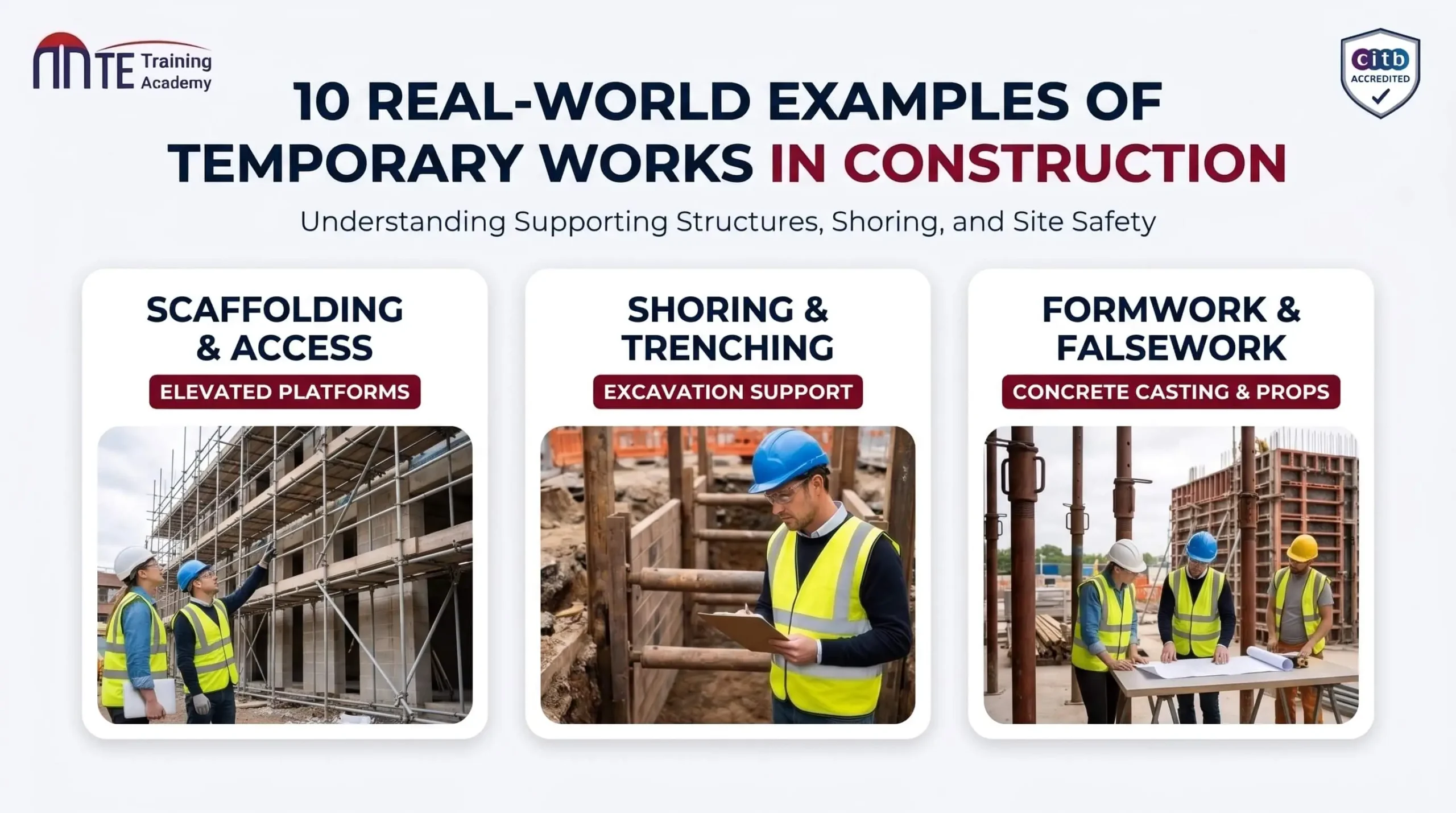
Editorial Disclosure: This technical guide was compiled by TE Training Academy's CITB-accredited instructional team using current BSI standards (BS 5975-1:2024 and BS 5975-2:2024), Health and Safety Executive (HSE) enforcement findings, and Temporary Works Forum (TWf) operational guidance.
What are examples of temporary works in construction?
In UK construction, temporary works are the engineered parts of a project needed to enable the construction, alteration, or demolition of permanent works, which are normally removed after completion. Common examples of temporary works in construction include falsework, concrete formwork, tube-and-fitting scaffolding, trench shoring, earthworks haul roads, mobile crane working platforms, facade retention frames, dewatering systems, site hoardings, and temporary propping. Under BS 5975-1:2024, all temporary works require a formal Temporary Works Register, an engineered Design Brief, independent design checks (Categories 0 to 3), and sign-off by a competent Temporary Works Coordinator (TWC) before loading or striking.
1. Defining Temporary Works: Why It Is Much More Than Scaffolding
Walk onto almost any UK building site and ask an operative what classes as temporary works, and nine times out of ten they will point at the nearest perimeter scaffold. That narrow assumption is one of the primary reasons temporary works fail.
According to BS 5975-1:2024 (Code of practice for temporary works procedures) and BS 5975-2:2024 (Design and implementation of falsework), temporary works encompass any engineered solution used to support, protect, provide access to, or stabilise permanent works or existing structures during construction activities.
Unlike permanent works, which receive months of architectural scrutiny and Building Safety Regulator (BSR) Gateway approvals, temporary works are frequently procured under intense programme pressure, exposed to dynamic construction loads, altered by multiple subcontractors, and erected on disturbed ground. Consequently, professionals managing these high-risk interfaces must complete an accredited CITB Temporary Works Coordinator (TWC) course to understand how statutory duties under Regulation 19 of CDM 2015 apply on site.
2. Summary Comparison: 10 Examples of Temporary Works & Risk Profiles
Use this reference matrix to identify the typical BS 5975 design check category, governing UK standard, and primary failure mechanism for the 10 most common temporary works packages on site:
| # | Temporary Works Example | Typical BS 5975 Check Category | Governing UK Standard / Guidance | Primary On-Site Failure Mechanism |
|---|---|---|---|---|
| 1 | Falsework & Backpropping | Cat 1 – Cat 3 | BS 5975-2:2024 / Eurocode 1 | Premature striking or overloading uncured concrete slabs |
| 2 | Formwork & Shuttering | Cat 0 – Cat 2 | CIRIA Report 108 / BS 8110 | Excessive concrete pour rate blowing out tie rods |
| 3 | Scaffolding & Temporary Roofs | Cat 0 (TG20) – Cat 2 | NASC TG20:21 / BS EN 12811 | Unauthorised tie removal by following trades & wind loading |
| 4 | Trench Shoring & Earthworks | Cat 1 – Cat 3 | BS 6031 / CIRIA C760 | Groundwater ingress, surcharge loads near trench edges |
| 5 | Crane & Piling Working Platforms | Cat 1 – Cat 2 | CIRIA C686 / BR 470 | Unrecorded underground voids or uncompacted sub-base |
| 6 | Facade Retention Systems | Cat 2 – Cat 3 | CIRIA C579 / BS 5975-1:2024 | Differential settlement of kentledge ballast blocks |
| 7 | Site Hoarding & Fencing | Cat 0 – Cat 1 | TWf Hoarding Guidance / BS EN 1991-1-4 | Wind uplift overturning under-ballasted posts |
| 8 | Haul Roads & Temporary Bridges | Cat 1 – Cat 2 | DMRB / BS 5975-1:2024 | Rutting, subgrade shear failure during wet weather |
| 9 | Structural Propping & Needling | Cat 1 – Cat 2 | BS 5975-1:2024 / Eurocode 3 | Eccentric loading, missing lateral lacing and bracing |
| 10 | Cofferdams & Dewatering | Cat 2 – Cat 3 | CIRIA C750 / BS EN 1997 (Eurocode 7) | Hydraulic uplift (piping/heave) and pump failure |
3. 10 Critical Examples of Temporary Works (And Why Each Fails)
1. Falsework and Multi-Storey Backpropping
What it is: Falsework consists of temporary vertical props, aluminium towers, and decking beams used to support wet reinforced concrete slabs, bridge decks, or precast elements until they become self-supporting. Backpropping distributes the weight of freshly poured upper floors down through lower, partially cured slabs.
Why it fails on site: Falsework collapses typically happen during the concrete pour or during striking. Common triggers include missing diagonal bracing, eccentric head-jack extensions exceeding manufacturer tolerances, foundation sole plates sinking into soft ground, or striking backprops before concrete cube tests confirm sufficient compressive strength.
2. Concrete Formwork and Vertical Shuttering
What it is: Formwork is the temporary mould into which fresh concrete is poured to form walls, columns, pile caps, and lift cores. While falsework carries vertical gravity loads, vertical formwork must resist intense lateral hydrostatic pressure from liquid concrete.
Why it fails on site: Site teams often underestimate how concrete pour speed, vibration, and low ambient temperatures increase hydrostatic wall pressure. If a concrete pump operator pours faster than the rate specified in the Temporary Works Design Brief (expressed in metres of rise per hour), tie rods snap and shutters blow out catastrophically.
3. Tube-and-Fitting or System Scaffolding (Beyond TG20 Compliance)
What it is: Access scaffolds, loading bays, cantilevered fans, and temporary roofs. Standard independent tied scaffolds may fall under a NASC TG20 compliance sheet (Category 0 standard solution), whereas complex scaffolds require bespoke CAD design calculations.
Why it fails on site: Scaffolds rarely fail because the steel tubes are weak; they fail due to unauthorised modifications. Bricklayers, cladding installers, or window fitters frequently remove structural scaffold ties to gain access to the facade without notifying the Temporary Works Supervisor (TWS) or Coordinator (TWC). Combined with debris netting or brick guards that increase wind sail area, an untied scaffold will buckle outward like a pack of cards.
4. Excavation Support, Trench Shoring, and Battering
What it is: Trench boxes, hydraulic walers, drag boxes, interlocking steel sheet piles, contiguous pile propping, and open-cut battered slopes used to prevent soil collapse during basement or drainage excavations.
Why it fails on site: Soil is a multiphase material whose shear strength changes rapidly with moisture. Excavations fail when site operatives assume cohesive clay will "stand up on its own" for a quick drainage connection, or when dumpers and excavators park directly on the zone of surcharge at the crest of a trench without being accounted for in the geotechnical design brief.
Upcoming CITB Temporary Works Coordinator (TWC) Courses
Do you or your site managers oversee scaffolding, excavations, crane mats, or propping on UK projects? Ensure full compliance with BS 5975-1:2024 and CDM 2015.
👉 Check Live Dates & Book Our 2-Day CITB Temporary Works Coordinator (TWC) Course (Available Online via Zoom & In-Person; CITB funding may be available through your local Employer Network)
5. Mobile Crane Outrigger Mats and Piling Working Platforms
What it is: Engineered granular stone mats (crushed concrete or Type 1 aggregate over geogrids) or timber/steel bog mats designed to spread extreme point loads from tracked piling rigs, MEWPs, and mobile cranes onto the underlying subsoil.
Why it fails on site: A 90-tonne piling rig has a high centre of gravity and exerts immense bearing pressures when slewing. Platforms fail when utility trenches are dug through a previously certified working platform and poorly backfilled without re-compaction or recertification under a fresh Permit to Load. One soft spot under a single track or outrigger causes immediate overturning.
6. Facade Retention Systems
What it is: Heavy-duty external steel trusses anchored to massive concrete kentledge blocks (or piled foundations) that hold up a historic or listed building facade while the internal structure behind it is demolished and rebuilt.
Why it fails on site: Facade retention systems remain in place for months or years and are subjected to high wind loads, thermal expansion, and vibration from adjacent demolition plant. Failures occur when temporary restraints between the masonry wall and the steel frame work loose, or when excavations undermine the kentledge foundation blocks.
7. Perimeter Site Hoarding and Heras Fencing
What it is: Timber or steel boundary hoardings, acoustic barriers, and ballasted temporary fencing separating live construction zones from public footpaths.
Why it fails on site: Site hoarding is frequently treated as a minor carpentry task rather than an engineered structure. In reality, a solid 2.4-metre hoarding acts as a giant wind sail. When advertising banners are attached without checking wind loading calculations (BS EN 1991-1-4), or when concrete ballast blocks are removed to let a delivery lorry through, winter gales blow hoardings directly onto members of the public.
8. Temporary Haul Roads, Access Ramps, and Bailey Bridges
What it is: Temporary site roads, embankment ramps into basement digs, culvert crossings, and temporary modular bridges built to carry articulated deliveries and 40-tonne articulated dump trucks (ADTs).
Why it fails on site: Inadequate surface water drainage softens the formation layer beneath the stone build-up, leading to deep rutting, slope instability along haul road embankments, and vehicle rollovers.
9. Internal Structural Propping, Needling, and Jacking
What it is: Acrow props, proprietary heavy-duty hydraulic shores (such as Mabey Mass 25 or RMD Megashor), and steel needle beams used when forming structural openings in load-bearing masonry or refurbishing existing commercial buildings.
Why it fails on site: Refurbishment propping is responsible for a disproportionate number of UK prosecutions. Failures happen when contractors prop off hollow-pot floors or rotten timber joists without checking the load path all the way down to a competent foundation, or when props are installed out-of-plumb without lateral lacing.
10. Cofferdams, Caissons, and Temporary Dewatering Systems
What it is: Watertight enclosures constructed from sheet piling or earth bunds, paired with sump pumps or wellpoint dewatering systems, allowing marine or below-water-table civil engineering works to proceed in the dry.
Why it fails on site: If standby dewatering pumps fail overnight or sheet pile clutches leak faster than calculated, hydrostatic pore pressure builds up beneath the base slab, causing catastrophic base heave or inward buckling of internal waler frames.
4. Real-World UK Temporary Works Failure Case Studies
Every delegate attending the CITB Temporary Works Coordinator training course at TE Training Academy examines real UK disasters to understand why procedural breakdowns, not mysterious engineering anomalies, cause collapses.
Case Study 1: The Loddon Viaduct Collapse (1972) - Birth of the Bragg Report
During the construction of a bridge over the River Loddon in Berkshire, the falsework supporting a large concrete viaduct span collapsed into the river during a pour, killing three workers and seriously injuring ten others.
- Root Cause: Inadequate lateral stability in the falsework grillage beams and lack of clear coordination between the permanent works designer, subcontractors, and site management.
- Industry Impact: The government commissioned Stephen Bragg, whose landmark Bragg Report (1975) established the fundamental doctrine that temporary works require the exact same degree of engineering care and procedural control as permanent works. This report led directly to the creation of BS 5975 and the role of the Temporary Works Coordinator (TWC). (Read our upcoming guide on CDM 2015 & The Bragg Report: The Legal Liabilities of Temporary Works for a full legal breakdown).
Case Study 2: The Milton Keynes Hotel Scaffold Collapse (2006)
A 100-foot (30-metre) perimeter scaffold surrounding a 279-bedroom hotel project in Milton Keynes collapsed "like a pack of cards" in less than 20 seconds, leaving two workers with life-threatening crush injuries.
- Root Cause: Intense deadline pressure led to uncoordinated modifications on site. Critical structural ties anchoring the scaffold to the building frame were missing or removed to facilitate facade work, and bracing at the base was insufficient to resist wind loads.
- Lesson for TWCs: A design check certificate means nothing if the physical installation on site deviates from the drawing or is altered without a formal change-control process.
Case Study 3: Hampstead Refurbishment Floor Collapse (HSE Prosecution)
During a major structural refurbishment in Hampstead, London, an inadequately supported floor collapsed during structural alterations, seriously injuring four operatives.
- Root Cause: The contractor failed to implement a formal system for managing temporary propping and sequencing structural alterations.
- Legal Outcome: The company was prosecuted by the HSE and found guilty of breaching Regulation 19(1) of the Construction (Design and Management) Regulations 2015 (CDM 2015). The HSE inspector noted the collapse was "completely avoidable had a proper system for managing temporary works been in place".
5. Why Temporary Works Fail on Site: The 5 Systemic Breakdown Points
When the Health and Safety Executive (HSE) or insurance forensic engineers investigate a structural collapse, they almost never find a mathematical error in Eurocode software. Instead, failures occur at the human and procedural interfaces:
- 1. Failure to Recognise Temporary Works Early: If an excavation, hoarding, or crane mat is never entered onto the Temporary Works Register before work starts, no design brief is written and no inspection takes place. (See our step-by-step guide on How to Create a Temporary Works Register & Design Brief for a downloadable checklist).
- 2. Incomplete or Inaccurate Design Briefs: Sending a Temporary Works Designer an architect's general arrangement drawing without site-specific soil bearing pressures, underground service locations, or concrete pour rates produces a design based on dangerous guesswork.
- 3. Assuming SMSTS Covers Temporary Works: Many Principal Contractors assume that holding a 5-day SMSTS qualification automatically makes a Site Manager competent to coordinate complex temporary works. In reality, SMSTS provides general site safety awareness, whereas coordinating BS 5975 procedures requires specialist training. (Explore our detailed comparison: Does SMSTS Qualify You to Manage Temporary Works?).
- 4. Skipping Pre-Load Inspections and Hold Points: Loading falsework, cranes, or scaffolds before a competent TWC or TWS physically inspects the installation against the approved drawing and signs off a Permit to Load.
- 5. Uncontrolled Site Alterations: Subcontractors moving a prop, cutting a waler, or removing scaffold ties to make room for permanent works without consulting the TWC.
6. How the "3 Ps" and BS 5975-1:2024 Prevent Structural Collapse
On the official CITB curriculum, preventing temporary works failures is structured around the "3 Ps" of Temporary Works Control:
- People (Competence & Appointment): Appointing a board-level Designated Individual (DI) to establish company procedures, a trained Temporary Works Coordinator (TWC) with the authority to stop unsafe work on site, and Temporary Works Supervisors (TWS) to carry out hands-on inspections. (Unsure which qualification your team needs? Read our breakdown of CITB TWCTC vs. TWSTC: Coordinator vs. Supervisor).
- Process (BS 5975-1:2024 Compliance): Maintaining a live Temporary Works Register, issuing comprehensive Design Briefs, matching Design Check Categories (0 to 3) to project risk, and enforcing strict Permit to Load and Permit to Strike hold points.
- Product (Materials & Equipment): Ensuring proprietary props, falsework components, ground anchors (BS 8539), and scaffolding tubes are free from corrosion or impact damage, erected strictly to manufacturer instructions, and verified via an Inspection and Test Plan (ITP).
Master the 3 Ps of risk management and learn how to coordinate complex excavations, formwork, and scaffolding safely with our CITB Temporary Works Coordinator (TWC) training course. Delivered over two days by industry-experienced instructors, our accredited TWCTC programme equips Site Managers, Civil Engineers, and Project Managers with the practical skills to pass the CITB assessment first time and protect lives on site.
7. Frequently Asked Questions (FAQs)
Under BS 5975-1:2024, temporary works are defined as the parts of a construction project needed to enable the permanent works to be built, which are typically removed once the permanent structure is self-supporting. Legally, their stability and safe management are governed by Regulation 19 of the Construction (Design and Management) Regulations 2015 (CDM 2015).
Yes. Both timber site hoardings and ballasted temporary fencing are classed as temporary works under BS 5975-1:2024. Because they are exposed to significant wind loading and sit directly adjacent to public highways, they must be recorded on the Temporary Works Register, designed for site-specific wind zones, and inspected regularly.
The Temporary Works Coordinator (TWC), formally appointed in writing by the Principal Contractor's Designated Individual (DI) is responsible for ensuring that a compliant design, independent design check, and pre-load physical inspection have been completed before signing a Permit to Load or Permit to Strike.
A CITB Temporary Works Coordinator (TWCTC) certificate is valid for 5 years. To maintain your qualification without retaking the full 2-day course, you must complete the 1-day CITB TWC Refresher (TWCTC-R) course before your current certificate expires.
Master Temporary Works Coordination with TE Training Academy
Whether you are a Site Manager, Civil Engineer, or Principal Contractor, ensuring full BS 5975-1:2024 and CDM 2015 compliance prevents costly site shutdowns and catastrophic structural failures.